The Fula language at a glance
Fula, also called Fulani, Pulaar, Pular or Fulfulde, is the language of the Fulani people, spoken across West and Central Africa from Senegal, Mauritania and Guinea to Nigeria, Cameroon and Chad. It is a Niger-Congo language of the Atlantic branch, written in the Latin alphabet, in Arabic-script Ajami and in Adlam, an alphabet created for Fula in Guinea. No census counts every speaker, but in Senegal alone 4.3 million people, 26.3% of those aged three and over, speak Pulaar most in daily life (ANSD, 2023 census).
- Where it is spoken: Senegal, Mauritania, The Gambia, Guinea, Mali, Burkina Faso, Niger, Nigeria, Cameroon, Chad and beyond, usually alongside other languages.
- Speakers: in Senegal alone, 4,314,509 people aged 3 and over (26.3%) speak Pulaar most in daily life (ANSD, 2023 census). No single census covers every country where Fula is spoken.
- Language family: Niger-Congo, Atlantic branch (with Sereer, its closest relative).
- Writing: the Latin alphabet (with ɓ, ɗ, ŋ, ƴ), Arabic-based Ajami, and Adlam, an alphabet created for Fula in Guinea.
- ISO 639-3 code:
ful(macrolanguage; Pulaar isfuc, Pularfuf) - Other names: Fulani, Fulfulde, Pulaar, Pular, Fulah, Peul (French).
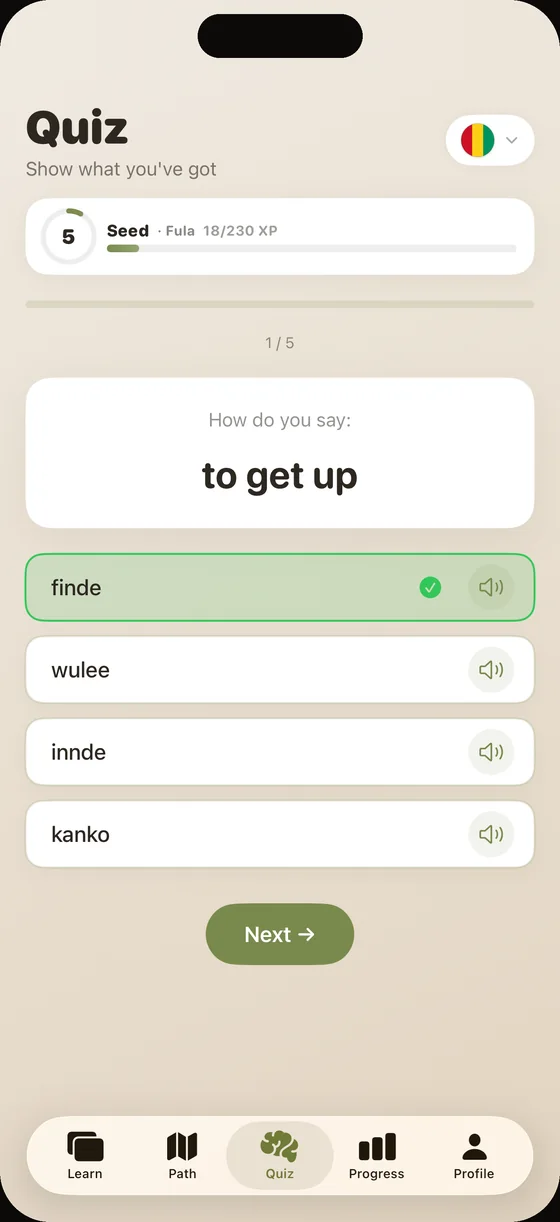
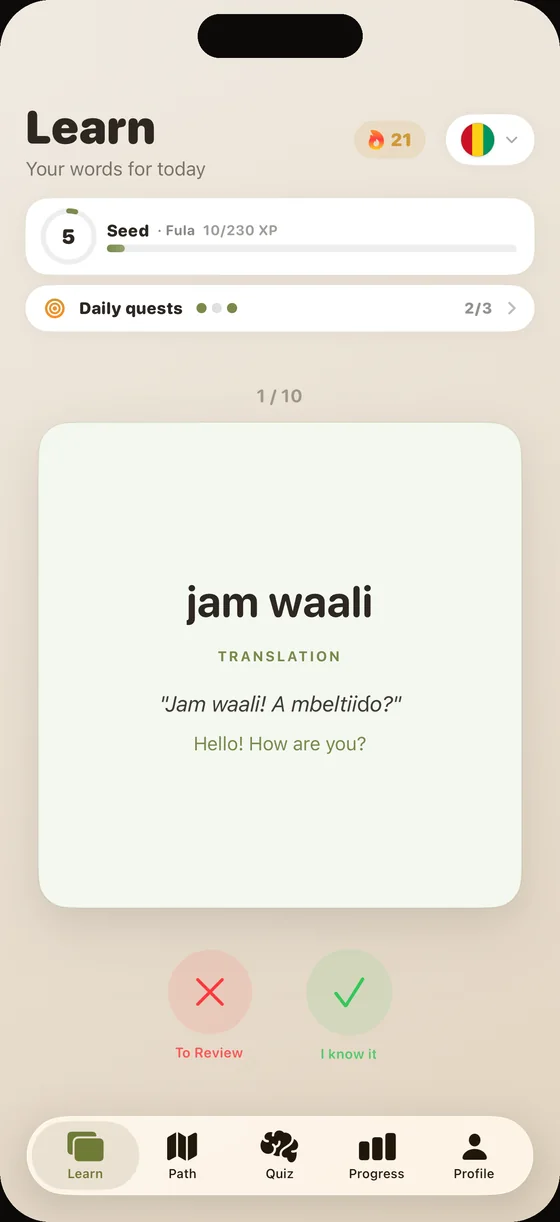
Want to hear it? Dialect teaches everyday Fula, in the Pulaar of Senegal, from English in five-minute sessions, with most words recorded by a native speaker. Your first greeting: jam waali, “hello.” Free to start.
Which app should you use to learn Fula?
As of November 2026, Duolingo, Babbel, Memrise and uTalk offer no Fula course. Learners rely on community apps, old free field-training courses, dictionaries and tutors. For Pulaar, the Fula of Senegal, a specialized app like Dialect gives you the everyday words and phrases, most of them with audio recorded by a native speaker, spaced repetition and five-minute sessions on iPhone, Android and the web. It's free to start and made for heritage learners, partners and volunteers. Pulaar and Fulfulde are only partly mutually intelligible.
For apps, courses and tutors side by side, see how to choose an app to learn Fula.
Fula, Fulani, Pulaar or Fulfulde: one language, several names
All of these names refer to the same language. Which one you hear depends mostly on where you are:
- Fula is the usual English name. Fulani is common in Nigeria and in a lot of English writing, and it is also the name of the people.
- Pulaar is what speakers call it along the Senegal River, in Senegal, Mauritania and The Gambia.
- Pular is the Fula of the Fouta Djallon highlands in Guinea.
- Fulfulde is the name used further east, from Mali and Burkina Faso to Niger, Nigeria and Cameroon.
- Peul is the French name, so you will see it on French-language sites.
So if you are wondering what language the Fulani speak, the answer is Fula, under whichever local name their region uses. Nearby varieties understand each other well; between distant ones, say the Pulaar of Senegal and the Fulfulde of Cameroon, understanding is only partial. Many Fulani also speak the main language of their country, such as Wolof in Senegal or Hausa in northern Nigeria.
The Fula taught in Dialect is the Pulaar of Senegal: the right choice if your family comes from the Senegal River valley, northern Senegal or southern Mauritania.
Is Fula one language or nine? Who created the Adlam alphabet, and where is Fula an official language? Our in-depth guide to the names, varieties and scripts of Fula answers all three.
Why learn Fula?
Fula (Pular in the west, Fulfulde in the east) is one of West Africa's great languages, spoken across a dialect continuum stretching nearly 5,000 km from Mauritania to Sudan. Learning Fula opens doors to multiple countries, cultures and oral traditions.
Dialect teaches the Pulaar of Senegal (Futa Toro), the variety of the Senegal River valley, also understood in Mauritania and Mali: it is not the Pular of Guinea. The words and sentences in the app are Pulaar.
Whether you are part of the diaspora or simply passionate about world languages, Dialect gives you the tools to progress quickly.
The Dialect Method
Our app combines playful learning with linguistic rigor:
- Essential vocabulary: learn the words most used in everyday life.
- Clear audio: hear how most words are pronounced.
- Interactive quizzes: test your knowledge and track your progress.
- Review mode: never lose what you've already learned.
The Science Behind Dialect
Dialect is built on well-tested findings from cognitive science:
- Spaced Repetition System (SRS): our algorithm calculates the optimal time to review each word, right before you would forget it.
- Clear audio: most words come with audio to guide your pronunciation.
- Small steps: each language is split into short units, so you never feel overloaded.
Fula in a few facts
- Language family: Atlantic branch of the Niger-Congo family.
- Speakers: no census covers every country where Fula is spoken, so estimates of the total vary from one source to another; in Senegal alone, 4.3 million people use Pulaar as their main everyday language (2023 census).
- Main regions: vast dialect continuum from Mauritania and Senegal to Chad and Sudan, including Mali, Burkina Faso, Niger, Nigeria and Cameroon.
- Writing systems: Latin alphabet (with additional characters like ɓ, ɗ, ŋ, ƴ); historically also Ajami (modified Arabic script).
Fula's most remarkable feature is its system of about twenty-five noun classes, which structures nouns, adjectives and agreements. The language carries great oral traditions (epics, religious poetry) and was central to the great Fula empires of the 19th century.
10 everyday Fula (Pulaar) words
The vocabulary people actually use at home or at the market. The right-hand column gives the full sentence in Fula, exactly as it appears in the app.
| English | Fula | Example |
|---|---|---|
| water | ndiyam | Miɗo yara ndiyam |
| to eat | ñaamde | Min ñaami |
| to drink | yarde | Miɗo yara ndiyam |
| bedroom | suudu | Suudu am ina mawni |
| mother | nene | Nene am ina defa |
| father | baaba | Baaba am ina golla |
| milk | kosam | Ɓinngel ngel ina yara kosam |
| market | luumo | Njahen luumo |
| tomorrow | janngo | En njahan janngo |
| a lot | sanne | A jaraama sanne |
Fula is also written in Adlam, an alphabet invented in the late 1980s by two Guinean teenagers, Ibrahima and Abdoulaye Barry, and added to Unicode in 2016. A word's initial consonant shifts with its class: pullo becomes fulɓe in the plural.
How Dialect makes learning Fula easier
Learning a heritage language when you live in the diaspora has unique challenges: few structured resources, materials often aimed at linguists rather than daily learners, and a critical shortage of reliable audio recordings. Dialect was built to address these obstacles.
Specifically for Fula, the app provides:
- Progress by frequency of use: you first learn words and phrases you will actually hear.
- Clear audio: consistent pronunciation from session one.
- Short sessions (5 cards a day): consistency beats intensity.
- Smart review: the spaced repetition algorithm presents each word right before you would forget it.
Hello, thank you and essential phrases in Fula
Looking to say hello in Fula, thank you or how are you? Here are the must-know greetings and polite phrases. Each one is available with audio in the Dialect app:
| English | Fula |
|---|---|
| Hello | jam waali |
| Hi | ey |
| Thank you | a jaraama |
| Yes | eey |
| No | alaa |
| Goodbye | jiidal e jam |
| Sorry | yaafo |
| How are you | no mbaɗa |
Transcriptions above are approximate: real pronunciation varies by region. To hear the pronunciation, listen to each phrase in Dialect.
Frequently asked questions about learning Fula
What is the best app to learn Fula?
First check the variety: Pulaar, the Fula of Senegal, and the Fulfulde of Nigeria or Cameroon are only partly mutually intelligible. Then look for native recordings, spaced repetition and the standard Latin spelling. As of November 2026, Duolingo and Babbel don't teach Fula; community apps, old free field-training courses and tutors are the other options. Dialect teaches Pulaar with native-speaker audio on most words, in five-minute sessions, free to start.
How do you say hello in Fula?
In Fula, "hello" is "jam waali". In casual settings you can also say "ey". Hear the pronunciation in the Dialect app.
How long does it take to learn the basics of Fula?
With Dialect, practicing 5 to 10 minutes a day, you can master essential Fula vocabulary in 4 to 6 weeks.
Is the Dialect app free?
Dialect is free to start: every day you get one session, one quiz and the Greetings lesson of the Path. Premium unlocks everything.
Is the Fula audio available in the Dialect app?
Yes, for most words: they come with audio recorded by a native speaker to help you memorize the pronunciation. The others are text only.
Do I need to know any West African language to start?
No. Dialect is designed for complete beginners.
Is Dialect available on Android?
Yes. The app is on Google Play. On desktop, Dialect runs directly in your browser through the web app (mydialect.io/app): same languages, the same audio, the same account. The native app is available on iPhone and iPad from the App Store.
What language do Fulani people speak?
Fula. Depending on the region, speakers call it Pulaar (Senegal, Mauritania, The Gambia), Pular (Guinea) or Fulfulde (from Mali to Nigeria and Cameroon). Many Fulani also speak the main language of the country they live in.
Where is Fula spoken?
Across West and Central Africa: from Senegal, Mauritania and Guinea through Mali, Burkina Faso and Niger to Nigeria, Cameroon and Chad, usually alongside other languages. In Senegal, 4.3 million people use Pulaar as their main everyday language (2023 census).
Are Pulaar and Pular the same language?
They are two closely related varieties of Fula. Pulaar is spoken along the Senegal River; Pular is the Fula of Guinea's Fouta Djallon. They share their grammar and much of their vocabulary but differ in some words and in pronunciation. Dialect teaches Pulaar.
How many people speak Fula?
No census counts Fula speakers in every country, so worldwide totals are estimates and vary between sources. The firmest figure comes from Senegal: in the 2023 census (ANSD, RGPH-5), 26.3% of people aged 3 and over, about 4.3 million, said Pulaar is the language they speak most in daily life.
Do Pulaar and Fulfulde speakers understand each other?
Only partly. Neighbouring varieties understand each other well, but between the Pulaar of Senegal and the Fulfulde of Nigeria or Cameroon, understanding is partial: the grammar is largely shared, while vocabulary and pronunciation differ enough to slow a conversation down. Dialect teaches the Pulaar of Senegal.
What alphabet is Fula written in?
Mostly the Latin alphabet, with extra letters for sounds English does not have: ɓ, ɗ, ŋ and ƴ. Fula has also long been written in Ajami, an Arabic-based script, and since the end of the 1980s in Adlam, an alphabet created for Fula in Guinea.
Is Fula hard to learn?
It asks for some patience. The spelling is regular and Fula has no tones to learn, but nouns fall into many noun classes that shape agreement, and the first sound of a word can change with its grammatical form. Short daily sessions on everyday words are the easiest way in.
Learning Fula (Pulaar): the essentials
No major platform offers a Fula (Pulaar) course: not Duolingo, not Babbel, not Memrise, not even uTalk, which covers more than 150 languages. Anyone wanting to learn it falls back on dictionaries, YouTube channels or private tutors. Dialect covers the everyday words and phrases of Fula (Pulaar), grouped by theme and reviewed with spaced repetition. The app is free for one session per day per language, on iPhone, iPad, Android and the browser.
Discover other languages on Dialect
Dialect offers many heritage languages to reconnect with your roots:
Start for free, today
Free daily session. On iPhone via the App Store, on Android via Google Play, or straight in the browser on desktop.

 Scan with your phone · iPhone or Android
On a computer?
Open the web application