Best app to learn Fula in 2026
You're looking for an app to learn Fula — called Pulaar, Pular or Fulfulde depending on the region — and you quickly run into the paradox: one of the most widespread languages of West Africa, spoken by tens of millions of people from Senegal to Cameroon, is missing from Duolingo, Babbel and Rosetta Stone. What does exist is scattered: community classes, YouTube channels, old textbooks, community-built apps in varying states of repair. This guide takes an honest tour of that landscape, and helps you choose based on your profile.
Which app should you use to learn Fula? Quick answer (November 2026): Duolingo, Babbel and Rosetta Stone don't teach Fula in any form. The options are community apps, multi-language African apps, old free FSI and Peace Corps courses, and YouTube. For Pulaar, the Fula of Senegal, a specialized app like Dialect offers the everyday words and phrases, almost all with audio recorded by a native speaker, spaced repetition and five-minute sessions on iPhone, Android and the web, free to start. It's made for Pulaar-speaking families, partners and volunteers; speakers of eastern Fulfulde will need to adapt — details below.
This page compares the tools that exist for learning Fula. For the language itself, called Fula in English and Pulaar in Senegal, see our page on the Pulaar language: where it is spoken, its names and scripts, and your first words.
Is Fula on Duolingo?
No. Duolingo does not teach Fula in any of its forms, whether Pulaar, Pular or Fulfulde (course list checked on November 18, 2026), and neither do Babbel or Rosetta Stone.
The options are community apps, multi-language African apps, the old free FSI and Peace Corps courses, and YouTube, compared below. For Pulaar, the Fula of Senegal, Dialect teaches everyday words and phrases, almost all with audio recorded by a native speaker: learn Fula with Dialect.
Why Fula needs a dedicated app
A major African language, absent from the major platforms
Fula is no obscure language: it is one of the most widely spoken languages of West Africa, present in some twenty countries, from the Senegal River to Lake Chad. The haalpulaaren — literally "those who speak Pulaar" — also form a large diaspora: in France above all, particularly around Paris, but also in the US and the UK, where the language lives on in families, community halls and hometown associations of the Senegal River valley. And yet no major learning platform offers it: not Duolingo, not Babbel, not Rosetta Stone. The result: those who want to learn it — children of the diaspora, spouses, the simply curious — end up improvising with a PDF from the 1960s, a YouTube channel and a vocabulary notebook. That is exactly the gap a dedicated app has to fill.
A continuum of varieties: Pulaar, Pular, Fulfulde
Fula forms a linguistic continuum that follows the history of Fula communities across the Sahel. It is called Pulaar in the Senegal River valley — the Futa Toro, between Senegal and Mauritania —, Pular in the Futa Jallon in Guinea, and Fulfulde further east, from Mali to Cameroon by way of Burkina Faso, Niger and Nigeria. The grammatical core is shared and mutual understanding is real, but pronunciation, certain turns of phrase and part of the vocabulary change from region to region. A good learning resource must therefore state clearly which variety it teaches — Dialect teaches Pulaar — rather than mixing words from across the continuum without saying so.
A noun-class language, with a script of its own
Fula belongs to the Atlantic language family, and its grammar looks like neither English nor French: no grammatical gender, but a system of noun classes — around twenty, depending on the variety — that governs agreement and even changes the first consonant of certain words. Disorienting on paper, natural in practice: you acquire it by memorizing words together with their surroundings, not by reciting tables. As for writing, Fula most often uses a Latin alphabet enriched with characters of its own — ɓ, ɗ, ŋ, ƴ — which mark sounds English doesn't have; there is also Adlam, an alphabet created in Guinea in the 1980s specifically for Fula. A generic, off-the-shelf course copied from another language misses all of this; you need content built for Fula, word by word.
The 4 criteria of a good Fula app
- A clearly identified variety — Pulaar, Pular or Fulfulde. If a resource just says "Fulani" without specifying, be wary: you risk learning a mix nobody actually speaks. Choose the variety of your family or the region closest to your heart.
- Everyday vocabulary first — greetings, family, polite phrases, food. Jam (peace, at the heart of every greeting) and a jaraama (thank you) should come in the first lessons, not "the airport" or "the hotel booking": you're learning Fula to talk to your own people.
- A real memorization system — spaced repetition brings each word back at the optimal moment, just before you forget it. Without it, you retain barely 20% of what you study — and Fula's noun classes are exactly the kind of thing that needs regular returns.
- Short sessions and visible progress — 5 minutes a day kept up for 3 months beats an hour every Sunday abandoned in January. The app should make consistency easy: daily streaks, milestones, levels, badges.
A word about your ear: whatever resource you choose, nothing replaces listening to native speakers — a call to family, Pulaar-language radio (the national-language newsrooms of Senegal and Mauritania stream online), the Haalpulaar creators on YouTube and TikTok. Make it a systematic complement to your reviews: the vocabulary learned in the app comes alive when you recognize it in a real conversation.
Dialect in practice, with screenshots
Dialect was built precisely for this use case: diaspora members and spouses who want to speak the family's language (again). Fula is treated as a language in its own right, with its variety stated up front — the Pulaar of Senegal (Futa Toro), the Senegal River valley variety also understood in Mauritania and Mali, not the Pular of Guinea — and its own script, characters ɓ, ɗ, ŋ and ƴ included.
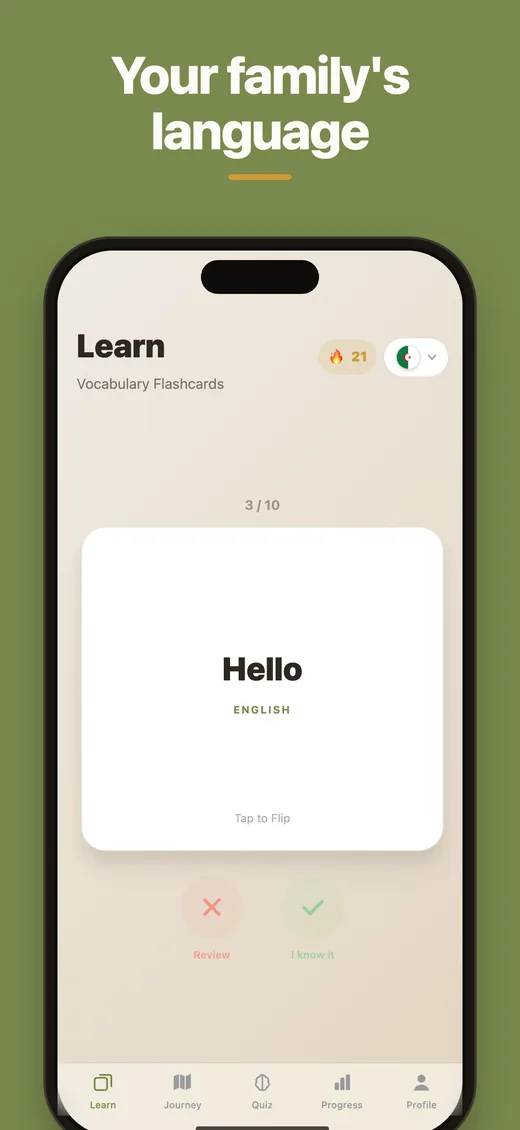
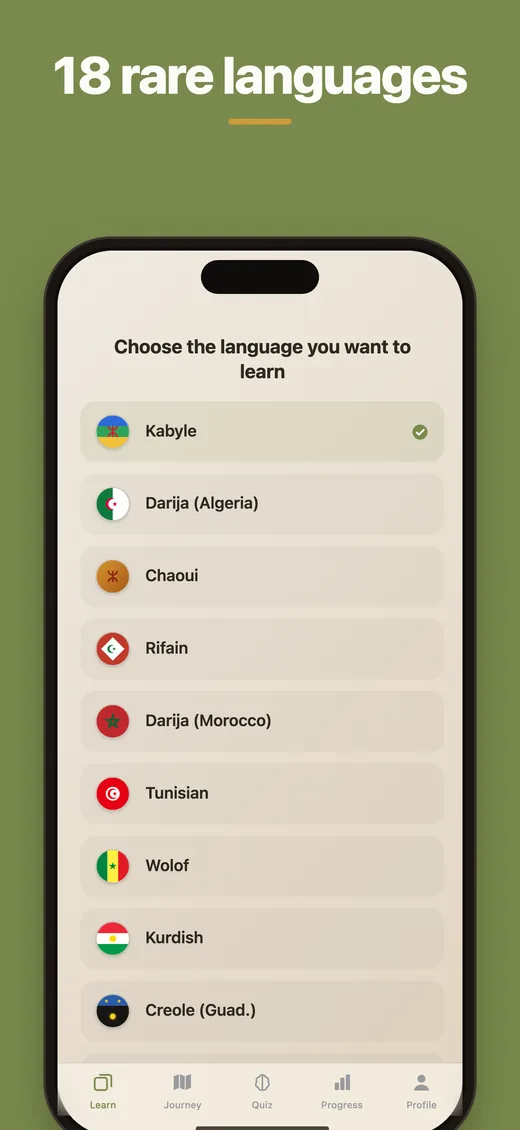
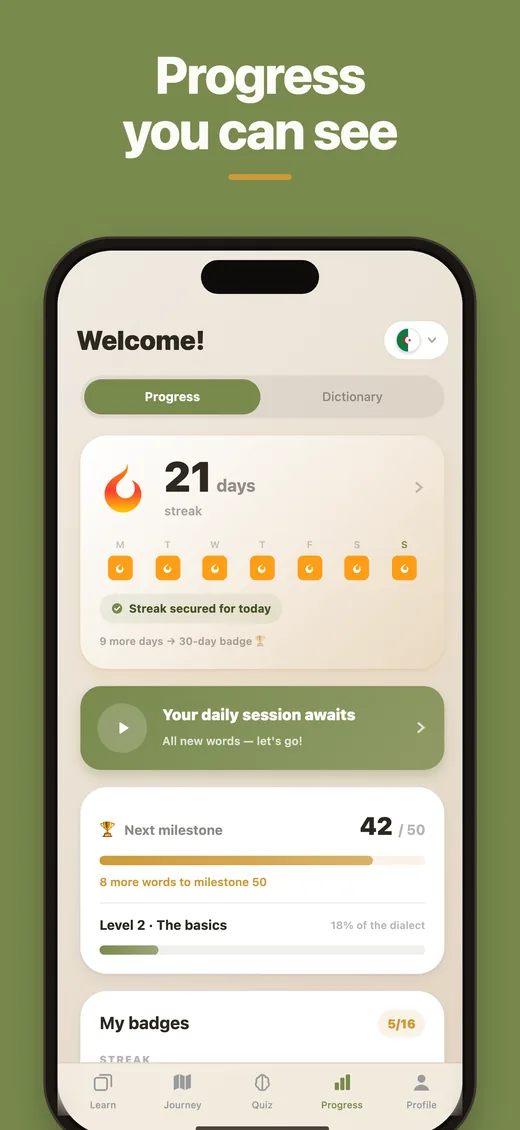
In concrete terms:
- A level-based Pulaar track: greetings, family, polite phrases, daily life — vocabulary in the order you'll need it on the phone with your own people.
- Flashcards and quizzes: each word works in both directions (into Pulaar and back), with example sentences written in correct Fula spelling.
- Spaced repetition: easy words space out, hard ones come back. Nothing to plan — the app decides what to review and when.
- 5-minute sessions, daily streaks, milestones (50, 100, 200 words…): built to fit a busy life.
- Free to start, on iPhone, Android and the web.
An honest comparison of the alternatives
No solution is perfect for everyone. Here is the real landscape in 2026:
The table is sorted by type of solution (major platforms, dedicated apps, courses, free resources), then alphabetically. Dialect, which publishes this guide, sits in its place like the others.
| Solution | Strengths | Limits for Fula |
|---|---|---|
| Duolingo / Babbel / Rosetta Stone | Proven methods, huge catalogs | Do not offer Fula in any form — not Pulaar, not Pular, not Fulfulde |
| Community apps | Built by enthusiasts, often free, vocabulary lists and dialogues | Coverage varies, little or no scheduled review, uncertain maintenance from one app to the next |
| Dialect | Level-based Pulaar track, flashcards and quizzes, spaced repetition, 5-min sessions, progress tracking, designed for the diaspora, on iPhone, Android and web | No formal grammar course; teaches Pulaar (speakers of eastern Fulfulde will need to adapt) |
| Multi-language African apps | Several African languages in one app, short lessons | Very broad catalog: check how many words and sentences exist for your language, and what stays available without a subscription |
| Historic free courses (FSI, Peace Corps — on Live Lingua) | Free, very thorough on grammar and dialogues | Designed decades ago for field workers: austere PDFs, no interactivity, no memorization tracking |
| YouTube, TikTok and community groups | Free, real immersion, active Haalpulaar creators, exchanges with speakers | No structure and no review system: perfect as a complement, insufficient on its own for durable memorization |
Offerings checked in November 2026.
Which solution for your profile?
- You're from the diaspora and want to talk with family: Dialect, starting with greetings and family vocabulary. Add calls back home — the best practice lab there is, and the finest encouragement.
- Your partner or in-laws are Fula: same path. A well-placed a jaraama at the right moment is worth any long speech — aim for your first 50 words before the next family gathering.
- You're preparing a stay in the Futa Toro, the Futa Jallon or the Sahel: Dialect for the everyday foundation, plus a structured course (community-run or online) for grammar if you're aiming for elaborate conversations. Check the local variety of your destination.
- You're curious about African languages, or a linguistics student: the historic FSI and Peace Corps courses remain gold mines for grammar and the noun-class system; Dialect will give you the living vocabulary and the consistency in parallel.
- You just want a few polite phrases: our free guides (how to say hello in 15 languages) and a week of Dialect are enough to greet people with dignity.
The method that works, whatever the app
An app is not everything: method is what makes you progress. Here is the one we recommend — and that Dialect orchestrates automatically:
- 5 to 10 minutes a day, every day. Consistency beats intensity, with no known exception in the research.
- Expose your ear in parallel. Pulaar radio, videos by Haalpulaar creators, and above all the conversations around you: listen, spot the words you've learned, repeat out loud.
- Trust the reviews. When a word comes back just as you thought you knew it, that is exactly when your memory needed it.
- Speak before you feel ready. From 50 words on, drop jam tan ("peace only", the answer to a greeting) and a jaraama into a family call. The smiles you'll get are worth all the badges.
Frequently asked questions
What is the best app to learn Fula?
First check the variety: Pulaar, the Fula of Senegal, and the Fulfulde of Nigeria or Cameroon are only partly mutually intelligible. Then look for native recordings, spaced repetition and the standard Latin spelling. As of November 2026, Duolingo and Babbel don't teach Fula; community apps, old FSI and Peace Corps courses and tutors are the other options. Dialect teaches Pulaar with native-speaker audio on most words, in five-minute sessions, free to start.
Pulaar, Pular, Fulfulde: what's the difference?
They are three regional names for one language, Fula, which forms a continuum: Pulaar in the Senegal River valley (Senegal, Mauritania), Pular in the Futa Jallon in Guinea, and Fulfulde from Mali to Cameroon by way of Niger, Burkina Faso and Nigeria. The underlying grammar is shared but speakers understand each other only in part; pronunciation and part of the vocabulary vary. Even thank you travels well: a jaraama is understood in the Pular of Guinea as well as the Pulaar of the Futa Toro. Dialect teaches Pulaar.
Which variety of Fula does Dialect teach?
Pulaar, the variety of the Senegal River valley (Senegal and Mauritania) — the one spoken by the majority of the Fula diaspora settled in France, and by many Pulaar-speaking communities abroad. Thanks to the language's shared core, a Pulaar learner is understood well beyond the Futa Toro, allowing for a period of adjustment to the accent and a few local words.
Do you need to know the characters ɓ, ɗ, ŋ and ƴ to get started?
No, not to get started. Fula is most often written in a Latin alphabet enriched with a few letters (ɓ, ɗ, ŋ, ƴ) that mark sounds specific to the language. You pick them up naturally as you meet the words — count a few days, not weeks. The Adlam alphabet, created in Guinea to write Fula, can come later if the subject interests you.
How long does it take to hold a simple conversation in Fula?
With regular practice of 5 to 10 minutes a day, most learners can handle simple exchanges (greetings, family, polite phrases) within 2 to 3 months. Consistency matters more than session length: that is the principle of spaced repetition.
What is the Fula audio like in Dialect?
Most words come with audio recorded by a native speaker; the others are text only. Fula spans a vast area from Senegal to Cameroon, with pronunciation varying widely between regions.
5 minutes a day · Free to start · 4.7/5 on the App Store
On a computer? Try the web app →