The Breton language at a glance
Breton (brezhoneg) is a Celtic language of the Brittonic branch, close to Welsh and Cornish, spoken in Brittany in north-western France. A 2024 survey for the Brittany Region estimated about 107,000 speakers aged 15 and over, half the 2018 figure. It is written in the Latin alphabet.
- Where it is spoken: Brittany, above all its western half (Lower Brittany), with learners and speakers across France.
- Speakers: about 107,000 people aged 15 and over in historic Brittany (between 93,000 and 120,500), against 214,000 in 2018 (Brittany Region / TMO survey, 2024).
- Language family: Indo-European, Celtic, Brittonic branch, like Welsh and Cornish.
- Writing: the Latin alphabet, with spellings such as c'h and ñ.
- ISO 639-3 code:
bre - Other names: brezhoneg (in Breton).
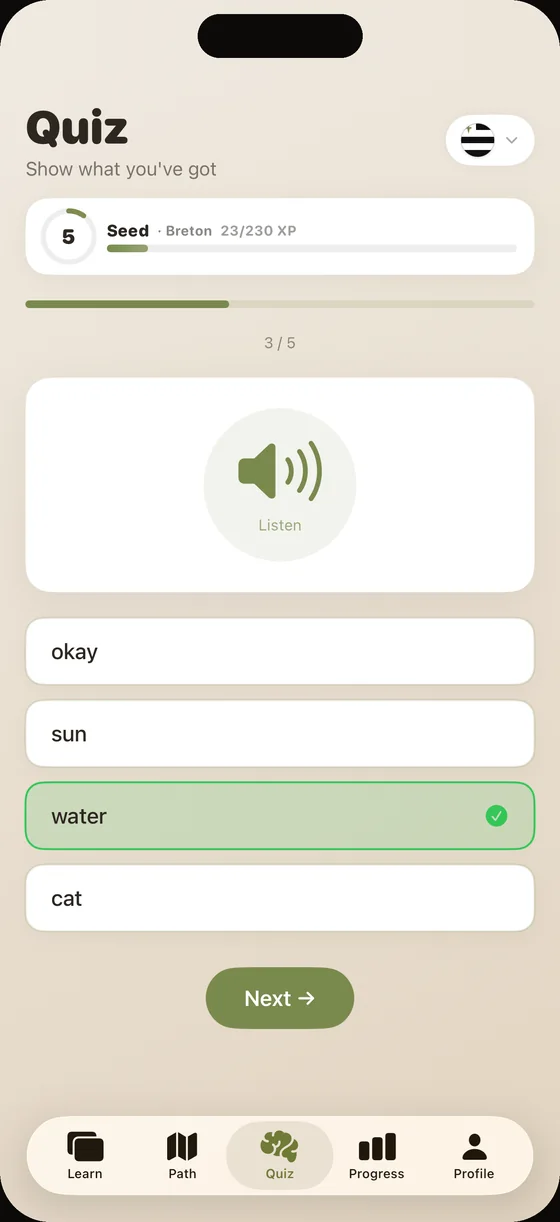
To speak it rather than read about it, Dialect teaches Breton from English in five-minute sessions, with clear audio for every word. Start your first session. Free to start.
Which app should you use to learn Breton?
As of November 2026, Duolingo and Babbel don't teach Breton, Memrise has only word lists made by its users, and uTalk covers phrase vocabulary. Evening classes, immersion courses and textbooks are the usual routes. To start speaking, a specialized app like Dialect gives you the everyday words and phrases with clear audio, spaced repetition and five-minute sessions on iPhone, Android and the web. It's free to start and made for people with Breton roots and anyone drawn to the language of Brittany.
For apps, courses and tutors side by side, see how to choose an app to learn Breton.
Why learn Breton?
Breton (brezhoneg) is a Celtic language of the Brittonic branch, a cousin of Welsh and Cornish. It was passed down for centuries in Brittany, until the chain broke in the 20th century: banned at school and stigmatized, the language often was not handed on to the children. Many families have Breton-speaking grandparents — and generations who never received the language.
Today Breton is experiencing a real revival: Diwan immersion schools, bilingual school tracks, Breton-language media. Whether you are the grandchild of Breton speakers, a Breton living in Paris or abroad, or simply drawn to Celtic languages, Dialect gives you the tools to pick the thread back up, a few minutes a day.
The Dialect Method
Our app combines playful learning with linguistic rigor:
- Essential vocabulary: learn the words most used in everyday life.
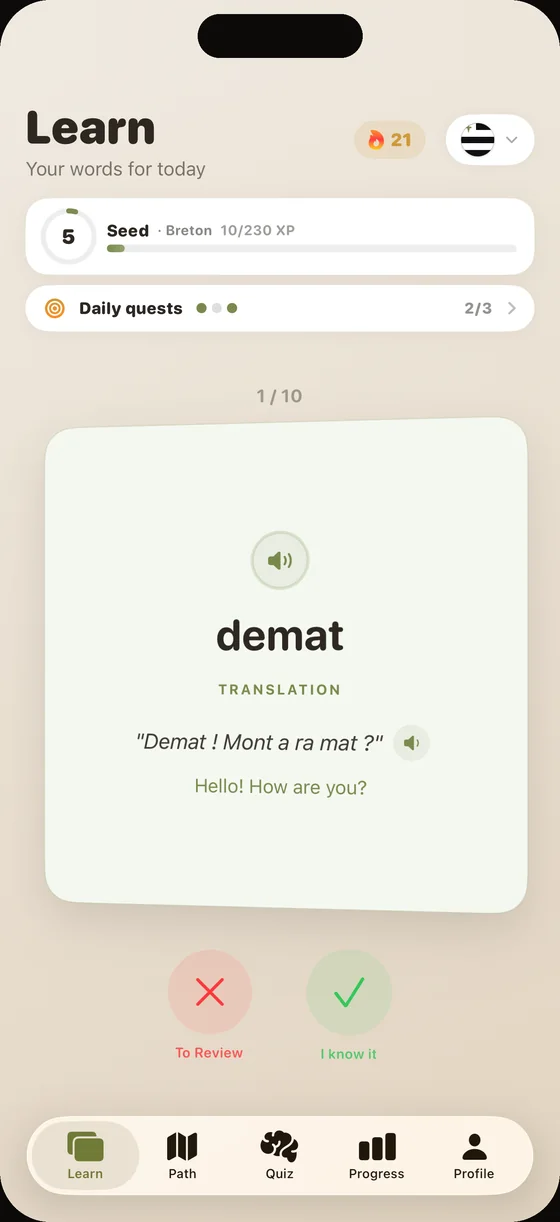
- Clear audio on every word: listen to each word and example sentence to calibrate your ear.
- Interactive quizzes: test your knowledge and track your progress.
- Review mode: never lose what you've already learned.
The Science Behind Dialect
To be among the best educational resources, Dialect builds on cognitive neuroscience principles:
- Spaced Repetition System (SRS): our algorithm calculates the optimal time to review each word, right before you would forget it.
- Auditory immersion: clear audio accompanies every word and sentence, so you learn with your ear as much as with your eyes.
- Granular learning: we break the language into manageable units to prevent cognitive overload.
Breton in a few facts
- Language family: Celtic, Brittonic branch — a cousin of Welsh and Cornish.
- Main region: Brittany, especially its western half, with many speakers and learners in Paris and across France.
- Transmission: broken in the 20th century (banned at school, stigmatized); many families have Breton-speaking grandparents and generations who never received the language.
- Revival: Diwan immersion schools, bilingual school tracks, the Ofis publik ar brezhoneg, and Breton-language media such as Brezhoweb.
- Writing system: Latin alphabet, with distinctive spellings such as c'h (ma c'hoar, "my sister") and letters like ñ.
Unlike French or the Romance languages, Breton descends from the language of the insular Britons. Its core vocabulary cannot be guessed: "hello" is demat, "thank you" is trugarez, "goodbye" is kenavo — a word even non-Breton speakers in Brittany know. It is a language to be learned on its own terms, with its own sounds and its own logic.
10 everyday Breton words
The vocabulary people actually use at home or at the market. The right-hand column gives the full sentence in Breton, exactly as it appears in the app.
| English | Breton | Example |
|---|---|---|
| water | dour | Evañ a ran dour |
| to eat | debriñ | Debret hon eus |
| to drink | evañ | Evañ a ran dour |
| home | ti | En ti emaon |
| mother | mamm | Ma mamm a gegin |
| father | tad | Ma zad a labour |
| child | bugel | Ar bugel a c'hoari |
| market | marc'had | Deomp d'ar marc'had |
| tomorrow | warc'hoazh | Mont a raimp warc'hoazh |
| a lot | kalz | Kalz a labour am eus hiziv |
Breton mutates its first consonant depending on the preceding word: tad (father) becomes ma zad (my father). It is a Celtic language, cousin to Welsh, unrelated to French.
How Dialect makes learning Breton easier
Relearning Breton when you did not receive it as a child has unique challenges: resources often designed for classroom courses, few materials suited to ten minutes of daily practice, and a language where nothing can be guessed from French or English. Dialect was built precisely to address these obstacles.
Specifically for Breton, the app provides:
- Progress by frequency of use: you first learn the words of everyday life — family, home, meals, greetings — the ones you will hear from the Breton speakers around you.
- Clear audio on every word: each word and example sentence plays in one tap, so you link spelling and sound from session one.
- Short sessions (5 cards a day): designed to fit into a routine, not replace it. Consistency beats intensity for long-term memory.
- Smart review: the spaced repetition algorithm presents each word right before you would forget it.
The goal is not just to know words, but to use your first phrases — a demat, a trugarez, a kenavo — with the Breton speakers in your family or community, and to restart a transmission that was interrupted.
Hello, thank you and essential phrases in Breton
Looking to say hello in Breton, thank you or how are you? Here are the must-know greetings and polite phrases. Tap Listen to hear each one:
| English | Breton | Listen |
|---|---|---|
| Hello | demat | |
| Hi | salud | |
| Thank you | trugarez | |
| Goodbye | kenavo | |
| Yes | ya | |
| No | nann | |
| Please | mar plij | |
| Sorry | digarez | |
| How are you | penaos emañ kont |
Clear audio on every word. For full pronunciation, offline access and the complete vocabulary, download the Dialect app or open the web app on desktop.
Frequently asked questions about learning Breton
What is the best app to learn Breton?
Check four things: clear audio on every word, everyday spoken Breton, spaced repetition, and a consistent spelling. As of November 2026, Duolingo and Babbel don't teach Breton; evening classes, immersion courses, textbooks and dictionaries are the other options. Dialect teaches everyday Breton with clear audio, in five-minute sessions, free to start.
How do you say hello in Breton?
In Breton, "hello" is "demat". Every word in the Dialect app comes with clear audio so you can work on your pronunciation.
Is Breton a Celtic language?
Yes. Breton (brezhoneg) is a Celtic language of the Brittonic branch, a cousin of Welsh and Cornish. It is neither a dialect of French nor a Romance language: its grammar and core vocabulary are its own.
How long does it take to learn the basics of Breton?
With Dialect, practicing 5 to 10 minutes a day, you can master essential Breton vocabulary in 4 to 6 weeks. Consistency matters more than session length: our spaced repetition algorithm optimizes long-term memorization.
Is the Dialect app free?
Dialect is free to start: every day you get one session, one quiz and the Greetings lesson of the Path. Premium unlocks everything.
Do I need to know any Breton to start?
No. Dialect is designed for complete beginners as well as people who heard Breton in their family without ever learning it. The app starts with the most-used daily vocabulary and progresses by category (greetings, family, meals, common verbs).
Is Dialect available on Android?
Yes. The app is on Google Play. On desktop, Dialect runs directly in your browser through the web app (mydialect.io/app): same languages, same audio, same account. The native app is available on iPhone and iPad from the App Store.
Where is Breton spoken?
In Brittany, in north-western France, above all in its western half, Lower Brittany. Learners and speakers also live across France, and Breton is taught in immersion schools in Brittany.
How many people speak Breton?
About 107,000 people aged 15 and over in historic Brittany, according to a 2024 survey for the Brittany Region, against about 214,000 in 2018. The number of speakers halved in six years, which is why passing the language on to new learners matters so much.
Learning Breton: the essentials
Neither Duolingo, nor Babbel, nor Memrise offers an official Breton course (Memrise only has word lists made by its users). It exists on uTalk, which teaches vocabulary and phrases rather than a structured course, and through a handful of private tutors — the offering stays thin. Dialect covers the everyday words and phrases of Breton, each with audio in one consistent voice throughout, grouped by theme and reviewed with spaced repetition. The app is free for one session per day per language, on iPhone, iPad, Android and the browser.
Discover other languages on Dialect
Dialect offers many heritage languages to reconnect with your roots:
Start for free, today
Free daily session. On iPhone via the App Store, on Android via Google Play, or straight in the browser on desktop.

 Scan with your phone · iPhone or Android
On a computer?
Open the web application