The Malagasy language at a glance
Malagasy is the national language of Madagascar and, with French, one of its two official languages. It is an Austronesian language whose closest relatives are spoken in Borneo, not in mainland Africa. It is spoken across the island, which counted 25.7 million inhabitants at its 2018 census.
- Where it is spoken: all over Madagascar, in regional varieties; also in Mayotte and among Malagasy communities in France and Réunion.
- Speakers: the national language of a country of 25,674,196 inhabitants at the 2018 census (INSTAT).
- Status: national language; official language together with French (Constitution of 2010, art. 4).
- Language family: Austronesian, Malayo-Polynesian branch.
- Writing: the Latin alphabet since the 19th century; earlier, Sorabe, an Arabic-based script.
- ISO 639-3 code:
mlg(macrolanguage; Plateau Malagasy isplt) - Other names: Malgache (French).
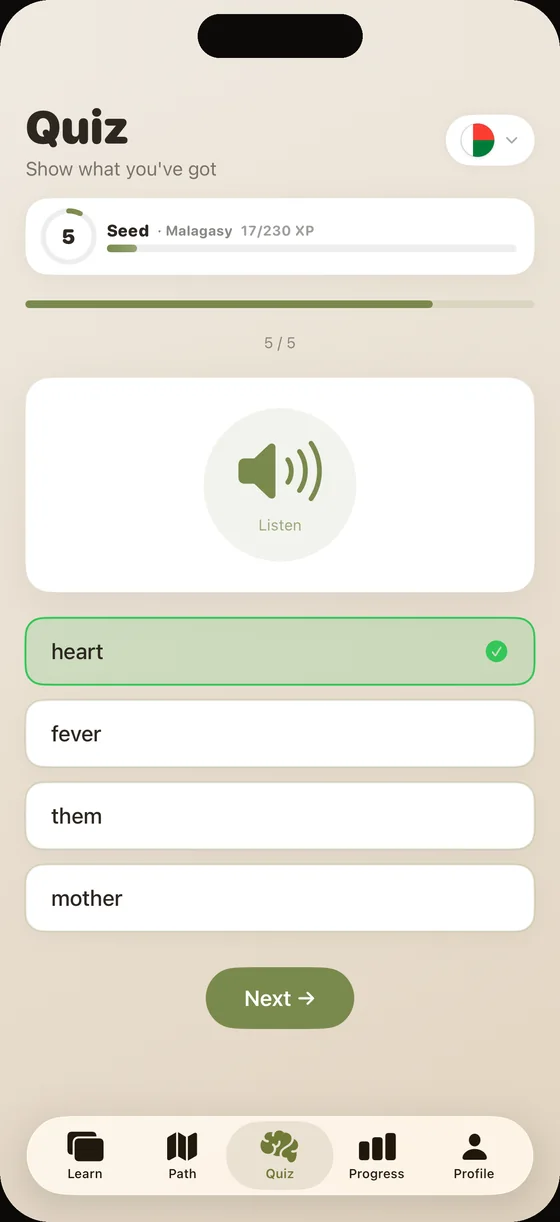
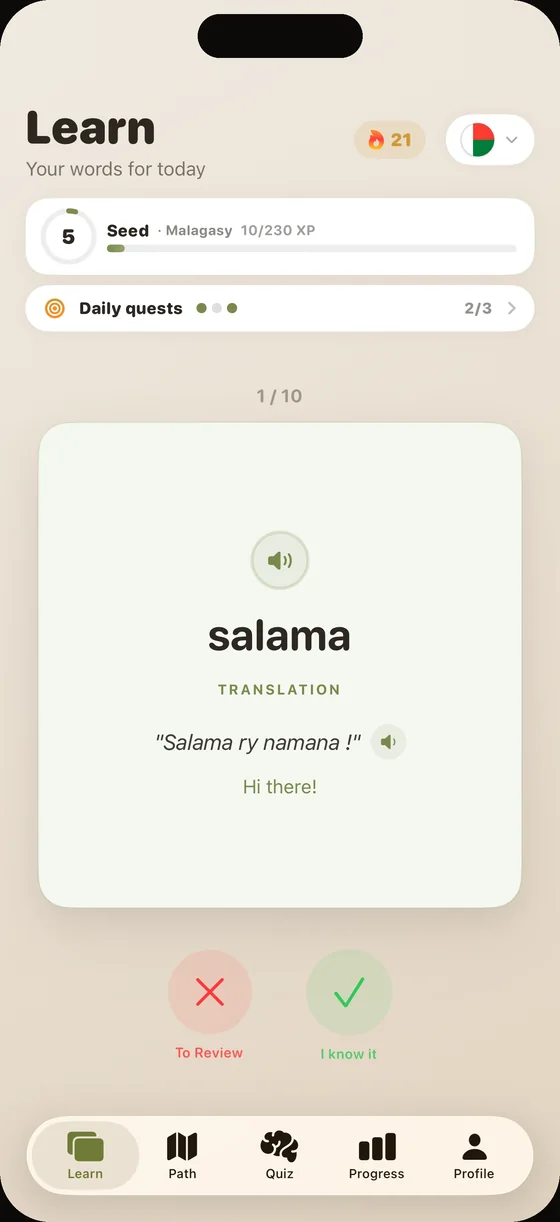
To speak it rather than read about it, Dialect teaches Malagasy from English in five-minute sessions, with a native speaker's voice. For more on the language itself, its origins, dialects and spelling, read our guide to the Malagasy language. Start your first session. Free to start.
Which app should you use to learn Malagasy?
As of November 2026, Duolingo and Babbel don't teach Malagasy, Memrise has only word lists made by its users, and uTalk covers phrase vocabulary. Associations, textbooks and online dictionaries make up the rest. For everyday Malagasy, a specialized app like Dialect gives you the essential words and phrases recorded by a native speaker, spaced repetition and five-minute sessions on iPhone, Android and the web. It's free to start and made for the Malagasy diaspora in France and Réunion, and for partners and travelers.
For apps, courses and tutors side by side, see how to choose an app to learn Malagasy.
Why learn Malagasy?
Malagasy is the national language of Madagascar, spoken all over the island. A remarkable fact: it is an Austronesian language, related to the languages of Borneo rather than to the languages of neighboring Africa — a legacy of the seafarers who crossed the Indian Ocean more than a thousand years ago.
Whether you are a child of the diaspora, married into a Malagasy family, or preparing a trip to the Great Island, Dialect gives you the tools to understand and be understood — in Antananarivo as well as around the family table.
The Dialect Method
Our app combines playful learning with linguistic rigor:
- Essential vocabulary: learn the words most used in everyday life.
- A native voice: listen to the words and their example sentences, recorded by a native speaker, as many times as you need.
- Interactive quizzes: test your knowledge and track your progress.
- Review mode: never lose what you've already learned.
The Science Behind Dialect
Dialect is built on well-tested findings from cognitive science:
- Spaced Repetition System (SRS): our algorithm calculates the optimal time to review each word, right before you would forget it.
- Auditory immersion: words and example sentences recorded by a native speaker, so your ear calibrates from session one.
- Granular learning: we break the language into manageable units to prevent cognitive overload.
Malagasy in a few facts
- Language family: Austronesian, Malayo-Polynesian branch — related to the languages of Borneo, not to the neighboring African languages.
- Speakers: the national language of a country of 25.7 million inhabitants (2018 census).
- Main regions: Madagascar (national language), with a large diaspora in France, Réunion, and Mayotte.
- Reference variety: Merina, spoken on the highlands around Antananarivo, the basis of official Malagasy.
- Writing system: Latin alphabet, adopted in the 19th century.
Official Malagasy, based on Merina, is taught in schools and understood across Madagascar, alongside regional varieties (Betsimisaraka, Sakalava, Antandroy…). The language has a rich oral tradition — proverbs, tales, the art of ceremonial speech known as kabary — and a written literature since the 19th century.
10 everyday Malagasy words
The vocabulary people actually use at home or at the market. The right-hand column gives the full sentence in Malagasy, exactly as it appears in the app.
| English | Malagasy | Example |
|---|---|---|
| water | rano | Misotro rano aho |
| to eat | misakafo / mihinana | Efa nisakafo izahay |
| to drink | misotro | Misotro rano aho |
| home | trano | Ao an-trano aho |
| mother | reny / neny | Mahandro ny neniko |
| father | ray / dada | Miasa ny dadako |
| child | zaza | Milalao ny zaza |
| market | tsena | Andao ho any an-tsena |
| tomorrow | rahampitso | Handeha isika rahampitso |
| a lot | betsaka | Misaotra betsaka |
Malagasy is not an African language: it is Austronesian, related to Ma'anyan of Borneo, 7,000 km away. The verb opens the sentence, before object and subject.
How Dialect makes learning Malagasy easier
Many children of the Malagasy diaspora share the same experience: you understand the conversations at home, you recognize Neny's and Dada's words, but you don't dare answer. Structured resources are rare, and often aimed at linguists rather than families. Dialect was built precisely to address these obstacles.
Specifically for Malagasy, the app provides:
- Progress by frequency of use: you first learn words and phrases you will actually hear at a family meal, on a call to Madagascar, or on a trip back home.
- A native voice: the words and example sentences can be played and replayed as many times as you need, to anchor the pronunciation.
- Short sessions (5 cards a day): designed to fit into a routine, not replace it. Consistency beats intensity for long-term memory.
- Smart review: the spaced repetition algorithm presents each word right before you would forget it.
The goal is not just to know words, but to hold a simple conversation with your grandparents, your cousins in Antananarivo, or your in-laws — and to pass the language to the next generation.
Hello, thank you and essential phrases in Malagasy
Looking to say hello in Malagasy, thank you or how are you? Here are the must-know greetings and polite phrases. Tap Listen to hear the pronunciation of each one:
| English | Malagasy | Listen |
|---|---|---|
| Hello | manao ahoana / salama | |
| Hi | salama | |
| Thank you | misaotra | |
| Please | azafady | |
| Yes | eny | |
| No | tsia | |
| Goodbye | veloma | |
| How are you | manao ahoana ianao | |
| I'm fine | salama tsara |
Recorded by a native speaker. For full pronunciation, offline access and the complete vocabulary, download the Dialect app or open the web app on desktop.
Frequently asked questions about learning Malagasy
What is the best app to learn Malagasy?
Check four things: audio recorded by a native speaker, because Malagasy pronunciation is hard to guess from its spelling, everyday spoken vocabulary, spaced repetition, and short daily sessions. As of November 2026, Duolingo and Babbel don't teach Malagasy; associations, textbooks and online dictionaries are the other options. Dialect teaches everyday Malagasy with a native voice, in five-minute sessions, free to start.
How do you say hello in Malagasy?
In Malagasy, "hello" is "Salama" or "Manahoana", and "Manao ahoana?" asks how you are. Hear them in the Dialect app, recorded by a native speaker.
Is Malagasy an African language?
No — and it is one of the most striking facts in linguistics: Malagasy is an Austronesian language, related to the languages of Borneo (Malayo-Polynesian branch), not to the languages of the neighboring African continent. It has been written in the Latin alphabet since the 19th century.
How long does it take to learn the basics of Malagasy?
With Dialect, practicing 5 to 10 minutes a day, you can master essential Malagasy vocabulary in 4 to 6 weeks. Consistency matters more than session length: our spaced repetition algorithm optimizes long-term memorization.
Is the Dialect app free?
Dialect is free to start: every day you get one session, one quiz and the Greetings lesson of the Path. Premium unlocks everything.
Do I need to know any Malagasy to start?
No. Dialect is designed for complete beginners as well as those who understand Malagasy without daring to speak it. The app starts with the most-used daily vocabulary and progresses by category (greetings, family, food, common verbs).
Is Dialect available on Android?
Yes. The app is on Google Play. On desktop, Dialect runs directly in your browser through the web app (mydialect.io/app): same languages, same audio, same account. The native app is available on iPhone and iPad from the App Store.
What language is spoken in Madagascar?
Malagasy, which is spoken all over the island in regional varieties. The standard language is based on the Merina variety of the central highlands. Malagasy and French are the two official languages, and French is widely used in administration and education.
Is Malagasy related to Indonesian?
Yes, distantly. Malagasy belongs to the Austronesian family, like Malay, Indonesian and the languages of the Philippines. Its closest relatives are languages of southern Borneo: part of the ancestors of the Malagasy sailed across the Indian Ocean many centuries ago, and others came from East Africa.
How is Malagasy written?
In the Latin alphabet, which has been used for Malagasy since the 19th century. Before that, it was written in Sorabe, an Arabic-based script used mainly in the south-east of the island.
Learning Malagasy: the essentials
Neither Duolingo, nor Babbel, nor Memrise offers an official Malagasy course (Memrise only has word lists made by its users). It exists on uTalk, which teaches vocabulary and phrases rather than a structured course, and through a handful of private tutors — the offering stays thin. Dialect covers the everyday words and phrases of Malagasy, recorded by a native speaker, grouped by theme and reviewed with spaced repetition. The app is free for one session per day per language, on iPhone, iPad, Android and the browser.
Discover other languages on Dialect
Dialect offers many heritage languages to reconnect with your roots:
Start for free, today
Free daily session. On iPhone via the App Store, on Android via Google Play, or straight in the browser on desktop.

 Scan with your phone · iPhone or Android
On a computer?
Open the web application