What is Kurmanji Kurdish?
Kurmanji, or Northern Kurdish, is the most widely spoken form of Kurdish. It is the Kurdish of Turkey and Syria, of the Duhok region of Iraqi Kurdistan, and of Kurdish communities in Iran, the Caucasus and the diaspora. It is written in the Latin alphabet, and it is the variety Dialect teaches.
- Where it is spoken: south-eastern Turkey, northern Syria, the Duhok region of Iraq, parts of Iran, Armenia and Georgia, and the diaspora, above all in Germany.
- Language family: Indo-European, Iranian branch, related to Persian.
- Writing: the Hawar alphabet, a Latin alphabet devised by Celadet Bedirxan in 1932.
- ISO 639-3 code:
kmr - Other names: Northern Kurdish, Kurmancî, Badini (in Iraq).
Kurmanji or Sorani? Sorani, or Central Kurdish, is the Kurdish of Erbil and Sulaymaniyah and of much of Iranian Kurdistan, and it is written in Arabic script. The two share a lot of vocabulary, but their grammar differs: Kurmanji keeps grammatical gender and case endings that Sorani has largely lost, so speakers of one often struggle to follow the other at first. If your family comes from Turkey, Syria or the Duhok area, Kurmanji is the one to learn.
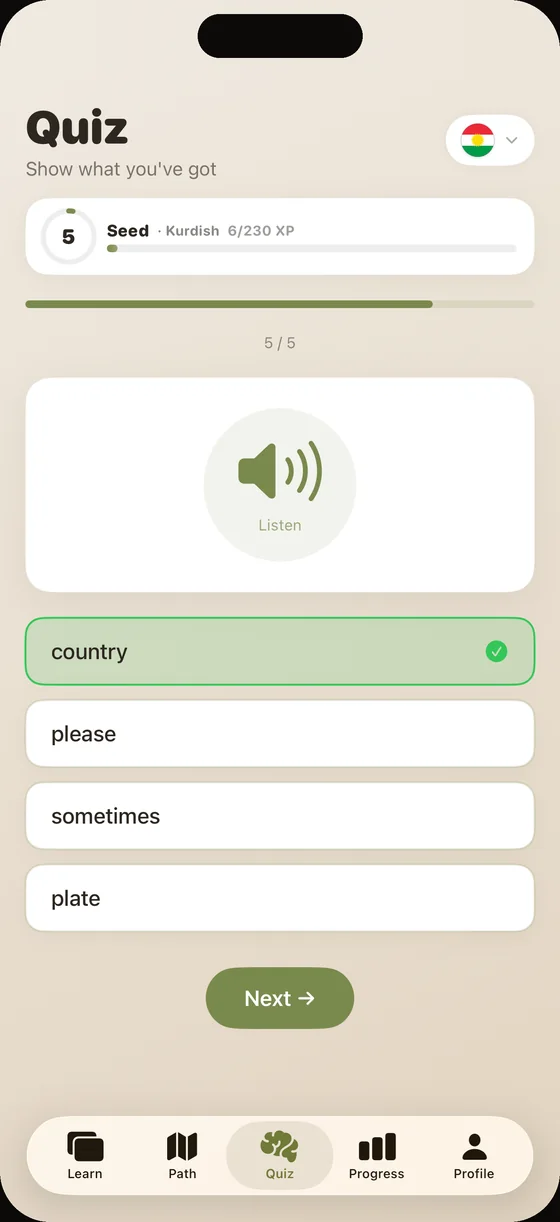
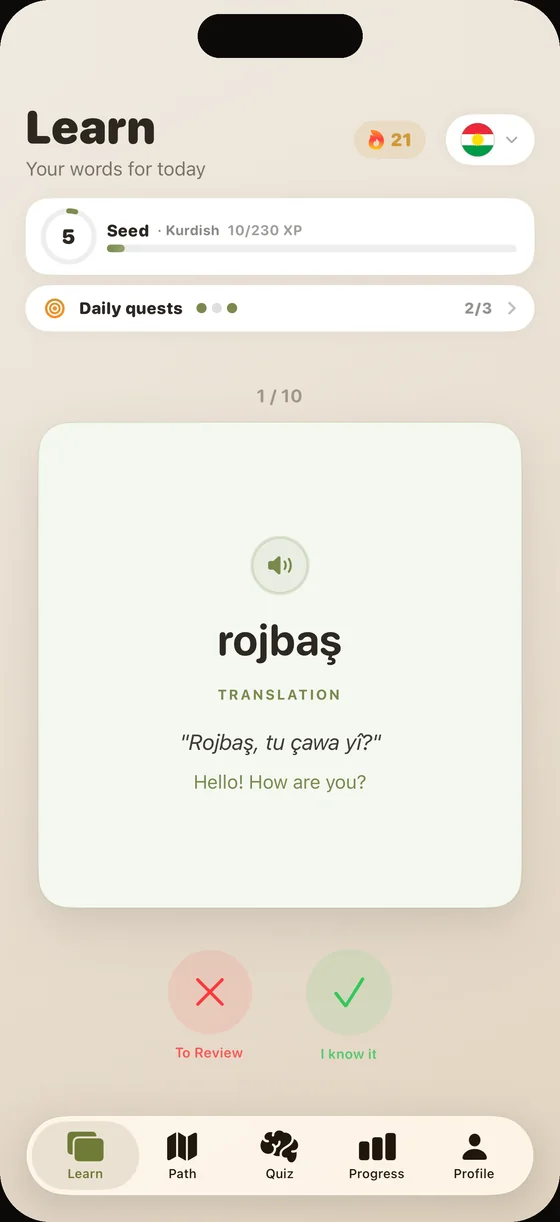
Dialect teaches everyday Kurmanji from English in five-minute sessions, from rojbaş (hello) to full sentences like Ez kurdî fêr dibim (I'm learning Kurdish). Start your first session. Free to start.
Which app should you use to learn Kurdish?
As of November 2026, Duolingo and Babbel offer no Kurdish course in any variety, and uTalk teaches Kurmanji as phrase vocabulary. The other routes are dedicated Kurdish apps, classes and private tutors. For spoken Kurmanji, a specialized app like Dialect gives you the everyday words and phrases recorded by a native speaker, with spaced repetition and five-minute sessions on iPhone, Android and the web. It's free to start and made for heritage learners and for partners of Kurdish families.
For apps, courses and tutors side by side, see Kurdish learning apps compared.
Why learn Kurdish?
Kurdish is the language of around 30 million people across Turkey, Iraq, Iran and Syria — and a vast diaspora in Germany, France, Sweden and the UK. Learning it is often an act of cultural affirmation, of reconnection with an identity preserved despite long-standing pressure.
Whether you are part of the diaspora or simply passionate about world languages, Dialect gives you the tools to progress quickly.
The Dialect Method
Our app combines playful learning with linguistic rigor:
- Essential vocabulary: learn the words most used in everyday life.
- Clear audio: hear how every word is pronounced.
- Interactive quizzes: test your knowledge and track your progress.
- Review mode: never lose what you've already learned.
The Science Behind Dialect
Dialect is built on well-tested findings from cognitive science:
- Spaced Repetition System (SRS): our algorithm calculates the optimal time to review each word, right before you would forget it.
- Clear audio: every word comes with audio to guide your pronunciation.
- Small steps: each language is split into short units, so you never feel overloaded.
Kurdish in a few facts
- Language family: Western Iranian language (Indo-European).
- Speakers: about 17 million for Kurmanji, the variety taught here; close to 30 million for Kurdish as a whole.
- Main regions: Kurdistan, divided between southeastern Turkey, northern Iraq, northwestern Iran and northern Syria, with major diaspora in Germany, France and Sweden.
- Writing systems: Latin alphabet for Kurmanji (Turkey, Syria), modified Arabic alphabet for Sorani (Iraq, Iran).
Kurdish is not a single language but a group of varieties that are not always mutually intelligible. The two main ones are Kurmanji (north, Latin alphabet) and Sorani (center, modified Arabic alphabet). Together with Arabic, Kurdish is one of the two official languages of Iraq. The language carries a rich and resilient literature, deeply tied to a stateless nation's identity.
10 everyday Kurdish (Kurmanji) words
The vocabulary people actually use at home or at the market. The right-hand column gives the full sentence in Kurdish, exactly as it appears in the app.
| English | Kurdish | Example |
|---|---|---|
| water | av | Ez av vedixwim. |
| to eat | xwarin | Ez birinc dixwim. |
| to drink | vexwarin | Ez av vedixwim. |
| home | mal | Mala min xweşik e. |
| mother | dê | Diya min xwarin çêdike. |
| father | bav | Bavê min li malê ye. |
| child | zarok | Zarok lîstik dike. |
| market | bazar | Ez diçim bazarê. |
| tomorrow | sibê | Ez ê sibê bêm. |
| a lot | gelek | Gelek spas. |
Kurmanji uses the Hawar Latin alphabet, devised in 1932, while southern Sorani uses Arabic script: two Kurds can speak Kurdish and still be unable to read each other.
How Dialect makes learning Kurdish easier
Learning a heritage language when you live in the diaspora has unique challenges: few structured resources, materials often aimed at linguists rather than daily learners, and a critical shortage of reliable audio recordings. Dialect was built to address these obstacles.
Specifically for Kurdish, the app provides:
- Progress by frequency of use: you first learn words and phrases you will actually hear.
- Clear audio: consistent pronunciation from session one.
- Short sessions (5 cards a day): consistency beats intensity.
- Smart review: the spaced repetition algorithm presents each word right before you would forget it.
Hello, thank you and essential phrases in Kurdish
Looking to say hello in Kurdish, thank you or how are you? Here are the must-know greetings and polite phrases. Each one is available with audio in the Dialect app:
| English | Kurdish |
|---|---|
| Hello | rojbaş |
| Hi | silav |
| Thank you | spas |
| Yes | erê |
| No | na |
| Goodbye | oxir be |
| Sorry | lêborîn |
| How are you | tu çawa yî |
Transcriptions above are approximate: real pronunciation varies by region. To hear the pronunciation, listen to each phrase in Dialect.
Frequently asked questions about learning Kurdish
What is the best app to learn Kurdish?
Check four things: words recorded by native speakers, the variety clearly stated (Kurmanji or Sorani), spaced repetition, and Kurmanji in its Latin alphabet. As of November 2026, Duolingo and Babbel don't teach Kurdish; uTalk has phrase vocabulary, and dedicated Kurdish apps, classes and tutors cover the rest. Dialect teaches Kurmanji with every word recorded by a native speaker, in five-minute sessions, free to start.
How do you say hello in Kurdish?
In Kurdish, "hello" is "rojbaş". In casual settings you can also say "silav". Hear the pronunciation in the Dialect app.
How long does it take to learn the basics of Kurdish?
With Dialect, practicing 5 to 10 minutes a day, you can master essential Kurdish vocabulary in 4 to 6 weeks.
Is the Dialect app free?
Dialect is free to start: every day you get one session, one quiz and the Greetings lesson of the Path. Premium unlocks everything.
Is the Kurdish audio available in the Dialect app?
Yes, every word comes with clear audio in the app to help you memorise the pronunciation.
Which Kurdish variety does Dialect cover?
Dialect currently focuses on Kurmanji, the most widely spoken Kurdish variety.
Is Dialect available on Android?
Yes. The app is on Google Play. On desktop, Dialect runs directly in your browser through the web app (mydialect.io/app): same languages, same native audio, same account. The native app is available on iPhone and iPad from the App Store.
Should I learn Kurmanji or Sorani?
Learn the one your family speaks. Kurmanji is the Kurdish of Turkey, Syria and the Duhok area of Iraq; Sorani is spoken in Erbil, Sulaymaniyah and much of Iranian Kurdistan. Dialect teaches Kurmanji.
Is Kurdish hard to learn?
Kurmanji is easier to start than many people expect: it is an Indo-European language, written in a Latin alphabet with regular spelling. The tricky part is the past tense of transitive verbs, which works differently from English (linguists call it ergative). A few minutes a day is enough to pick up everyday words like spas (thank you) and short sentences like Ez kurdî diaxivim (I speak Kurdish).
Learning Kurdish (Kurmanji): the essentials
Neither Duolingo, nor Babbel, nor Memrise offers an official Kurdish (Kurmanji) course (Memrise only has word lists made by its users). It exists on uTalk, which teaches vocabulary and phrases rather than a structured course, and through a handful of private tutors — the offering stays thin. Dialect covers the everyday words and phrases of Kurdish (Kurmanji), each with audio in a native speaker's voice, grouped by theme and reviewed with spaced repetition. The app is free for one session per day per language, on iPhone, iPad, Android and the browser.
Discover other languages on Dialect
Dialect offers many heritage languages to reconnect with your roots:
Start for free, today
Free daily session. On iPhone via the App Store, on Android via Google Play, or straight in the browser on desktop.
 Scan with your phone · iPhone or Android
On a computer?
Open the web application