Best app to learn Wolof in 2026
You're looking for an app to learn Wolof — the most widely spoken language of Senegal, also present in Gambia and Mauritania — and you quickly discover the problem: Duolingo, Babbel and the other big consumer apps simply don't offer it. For a language millions of people speak every day, from Dakar to Saint-Louis to Senegalese families across Europe and North America, the digital options are surprisingly thin: a few university courses, YouTube videos, two or three small apps. This guide takes an honest tour of what really exists, and helps you choose based on your profile.
Which app should you use to learn Wolof? Quick answer (November 2026): Duolingo, Babbel and Rosetta Stone don't teach Wolof; uTalk has travel phrases, and Memrise only word lists made by its users. Beyond that: multi-language African apps, university or community courses and private tutors. For the Wolof spoken in Dakar and at home, a specialized app like Dialect offers the everyday words and phrases, recorded by a native speaker, with spaced repetition and five-minute sessions on iPhone, Android and the web, free to start. It's made for the Senegalese diaspora, partners and volunteers heading to Senegal — details below.
This page compares the tools that exist for Wolof. If you have already made up your mind, go straight to learn Wolof with the Dialect app: everyday words and phrases, recorded by a native speaker.
Does Duolingo have Wolof?
No. Duolingo does not teach Wolof (course list checked on November 18, 2026), and neither do Babbel or Rosetta Stone, even though Wolof is the language most spoken day to day in Senegal (53.5% of people aged 3 and over, ANSD 2023 census).
What does exist: uTalk travel phrases, word lists made by Memrise users, multi-language African apps, university or community courses and private tutors, compared below. For the Wolof spoken in Dakar and at home, Dialect teaches everyday words and phrases recorded by a native speaker: learn Wolof with Dialect.
Why Wolof needs a dedicated app
A Niger-Congo language, not a "derivative" of any other
Wolof belongs to the Niger-Congo family, Atlantic branch — the same broad family as Fula and Serer. It has no family relationship to English, French or Arabic, despite the loanwords centuries of contact have left behind: salamalekum (the greeting that came from Arabic) and jërëjëf sit alongside French words that entered everyday use in Dakar. Concretely, that means an English speaker can't "guess" anything: ndox (water), kër (house), xale (child) resemble nothing you know. That is also what makes learning it rewarding — every word learned is a real conquest — but it demands a tool that brings vocabulary back methodically, not a mere list to read once.
Noun classes instead of grammatical gender
Where French sorts every noun into masculine or feminine, Wolof uses a system of noun classes: the definite article comes after the noun and changes with the class — xale bi (the child), kër gi (the house), nit ki (the person). Eight classes in the singular, two in the plural. It's disorienting at first, then becomes a reflex once you've heard the words with their articles enough times. More good news besides: Wolof is not a tonal language, it is written in the Latin alphabet with an official orthography, and the verb doesn't conjugate — the pronouns (maangi, dinaa…) carry tense and aspect. Far fewer endings to memorize than in French!
A living culture — and a diaspora that wants its language back
Wolof is the language of teranga, that Senegalese hospitality which became the nickname of the whole country — "the land of Teranga". It's the language of mbalax, carried by Youssou N'Dour and so many others, heard at weddings and diaspora celebrations. In France, home to one of the oldest sub-Saharan African communities in Europe — and increasingly in the US, the UK and Canada — a whole generation grew up hearing Wolof at home: many understand it without speaking it. Answering waaw when the aunt calls, but being unable to tell her about your day. It is precisely for that audience — and for partners, travelers, the curious — that an app centered on everyday spoken language changes everything.
The 4 criteria of a good Wolof app
- Clear, systematic audio on the vocabulary — the sounds of Wolof (the guttural x of xale, the prenasalized consonants mb, nd as in mbalax, the doubled consonants of rekk) cannot be guessed from the page: every word must be listenable, as many times as needed. And on top of that, listen to real speakers: family, Senegalese music, YouTube creators.
- Everyday vocabulary first — greetings, family, food, the market. Not "the airport" and "the hotel reservation" in lesson 2: you're learning Wolof to talk to people, not for a business trip.
- A real memorization system — spaced repetition brings each word back at the optimal moment before you forget it. Without it, you retain a fraction of what you study — especially when no word resembles anything you know.
- Short sessions and visible progress — 5 minutes a day kept up for 3 months beats an hour every Sunday abandoned in January. The app should make consistency easy (streaks, milestones, reminders).
Dialect in practice, with screenshots
Dialect was built precisely for this use case: the diaspora and their loved ones who want to speak the family's language (again). Wolof appears there as a language in its own right, alongside 18 other languages the big consumer apps leave out.
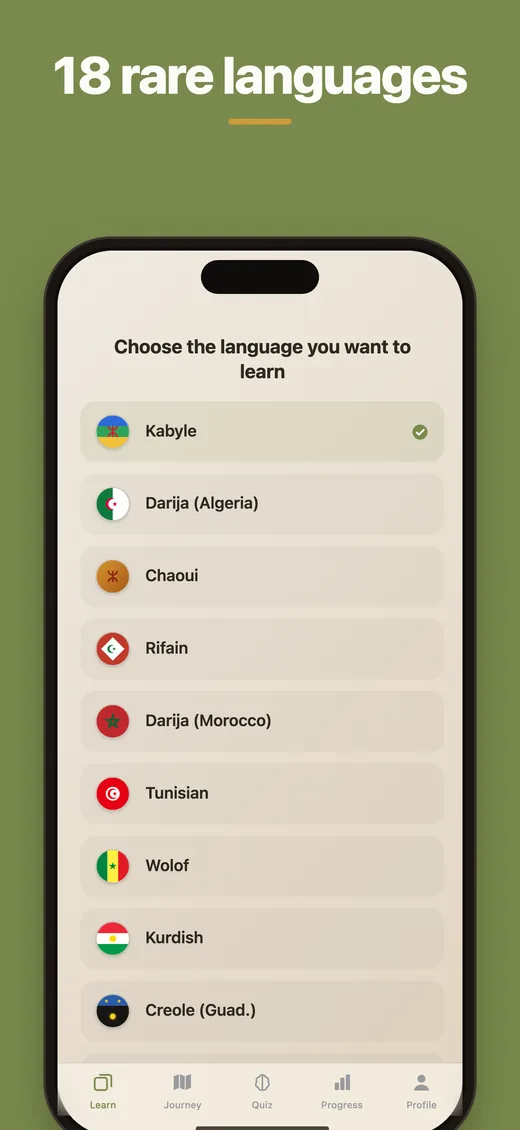
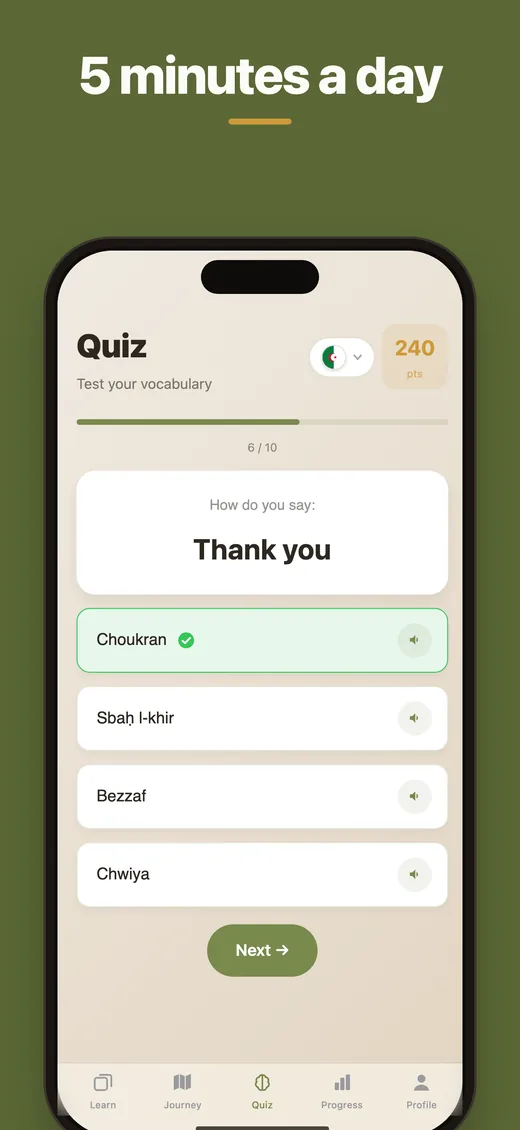
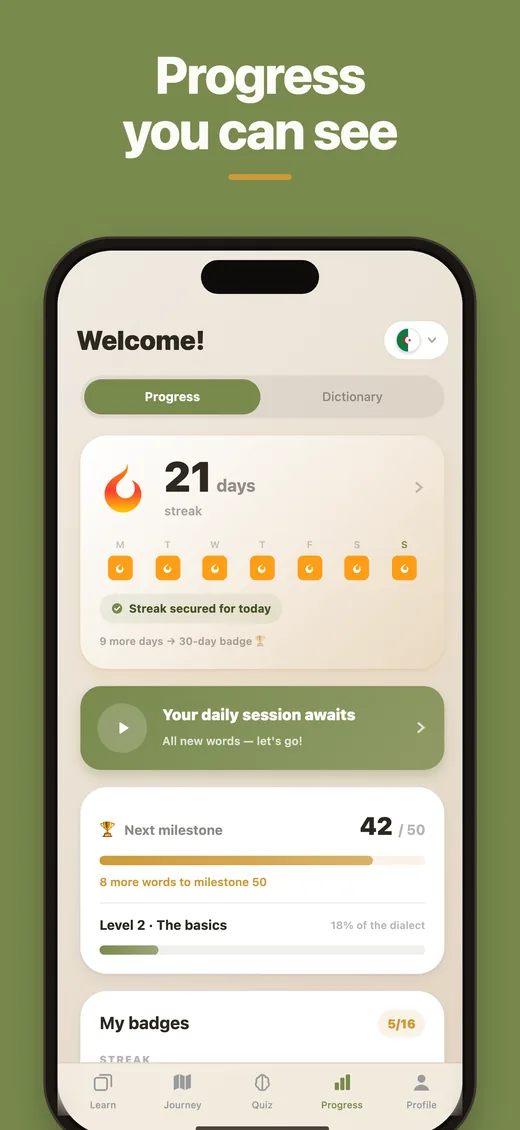
In concrete terms:
- Wolof treated as a language in its own right: not a chapter at the back of a generalist course, but its own track, its own vocabulary, its own everyday phrases.
- Native audio on the vocabulary: every word and every phrase can be played with one tap, as many times as needed, to anchor jërëjëf, nanga def or ba beneen in your ear before you say them.
- Flashcards, quizzes and level-based tracks with spaced repetition: words you've mastered space out, hard ones come back.
- 5-minute sessions, daily streaks, milestones (50, 100, 200 words…): built to fit a busy life.
- Free to start, on iPhone, Android and the web.
An honest comparison of the alternatives
No app is perfect for everyone. Here is the real landscape in 2026:
The table is sorted by type of solution (major platforms, dedicated apps, courses, free resources), then alphabetically. Dialect, which publishes this guide, sits in its place like the others.
| Solution | Strengths | Limits for Wolof |
|---|---|---|
| Duolingo / Babbel / Rosetta Stone | Proven methods, huge catalogs | Do not offer Wolof. None of these three covers Senegal's most widely spoken language |
| uTalk | Wolof is in the catalog; practical phrases sorted by theme | A "travel phrases" recognition-based approach, with no planned review system |
| Dialect | Wolof treated as a language in its own right, everyday vocabulary, native audio, spaced repetition, 5-min sessions, designed for the diaspora, on iPhone, Android and web | No formal grammar course (noun classes are best deepened elsewhere) |
| Memrise, user-made word lists (back in the app in 2026) | Wolof lists created by other users, flexible flashcards | Uneven coverage from list to list, audio not systematic; made by users rather than by Memrise |
| Multi-language African apps | Several African languages in one app, short lessons | Very broad catalog: check how many words and sentences exist for your language, and what stays available without a subscription |
| University and community courses (INALCO in Paris, Senegalese associations…) | Real grammatical depth, qualified teachers, group speaking practice | A school rhythm, fixed schedules, limited seats, not suited to 5 minutes on the subway; ideal as a complement to daily practice |
| YouTube / music / family | Free, real immersion, excellent Senegalese creators, and mbalax as a sound bath | No structure or review: perfect as a complement, insufficient on its own for durable memorization |
Offerings checked in November 2026.
Which solution for your profile?
- You're from the diaspora and want to talk with family: Dialect, starting with greetings and family vocabulary. Already understand a lot? All the better: the quizzes will turn that passive vocabulary into words you dare to say. Round it out with calls back home — the best laboratory there is.
- Your partner or in-laws speak Wolof: Dialect for the daily foundation, plus a ritual — a sincere nanga def? on every call. The effect on the in-laws is immediate.
- You're moving to or traveling in Senegal: French will get you by in Dakar, but Wolof opens doors — at the market, in taxis, everywhere teranga is lived. Two or three weeks of Dialect before departure cover the basics of politeness.
- You're aiming for deep mastery (grammar, writing, oral literature): a structured course — university-level, like INALCO's, or community-run — for the theory, and daily app practice so the vocabulary sticks. The two reinforce each other.
The method that works, whatever the app
An app is not everything: method is what makes you progress. Here is the one we recommend — and that Dialect orchestrates automatically:
- 5 to 10 minutes a day, every day. Consistency beats intensity, with no known exception in the research.
- Audio from day one. Listen to each word several times, repeat out loud — even alone in your kitchen. And bathe your ear in real Wolof: family, mbalax, videos by Senegalese creators.
- Trust the reviews. When a word comes back just as you thought you knew it, that is exactly the moment your memory needed it.
- Speak before you feel ready. From 50 words on, drop salamalekum, nanga def? and jërëjëf into a family call. The smiles you'll get are worth all the badges.
Frequently asked questions
What is the best app to learn Wolof?
Check four things: words recorded by native speakers, the Wolof actually spoken in Senegal, spaced repetition, and the standard Latin spelling. As of November 2026, Duolingo and Babbel don't teach Wolof; uTalk has travel phrases, and courses, tutors and multi-language African apps cover the rest. Dialect teaches everyday Wolof with every word recorded by a native speaker, in five-minute sessions, free to start.
Is Wolof hard to learn for an English speaker?
Wolof is a Niger-Congo language with no family relationship to English: the vocabulary is entirely new and the noun-class system takes some getting used to. But there is good news: Wolof is not a tonal language, it is written in the Latin alphabet, and its conjugation relies on invariable pronouns rather than endings to memorize. With regular practice, the first conversations come quickly.
How long does it take to hold a simple conversation in Wolof?
With a regular practice of 5 to 10 minutes a day, most learners can handle simple exchanges (greetings, family news, the market) within 2 to 3 months. Wolof greetings — Salamalekum, Nanga def?, Maangi fi rekk (I'm fine) — can be learned in the very first week and immediately open conversations. Consistency matters more than session length: that is the principle of spaced repetition.
I understand Wolof but I don't speak it: can that be fixed?
Yes, and it is actually the most favorable starting point. Many children of the Senegalese diaspora grew up hearing Wolof without ever speaking it: their ear is already trained, their passive vocabulary exists. What's mostly missing is active practice — saying the words out loud, retrieving them from memory. That is exactly what flashcards and quizzes with spaced repetition work on: turning vocabulary you understand into vocabulary you speak. Our guide to learning your heritage language maps out that path.
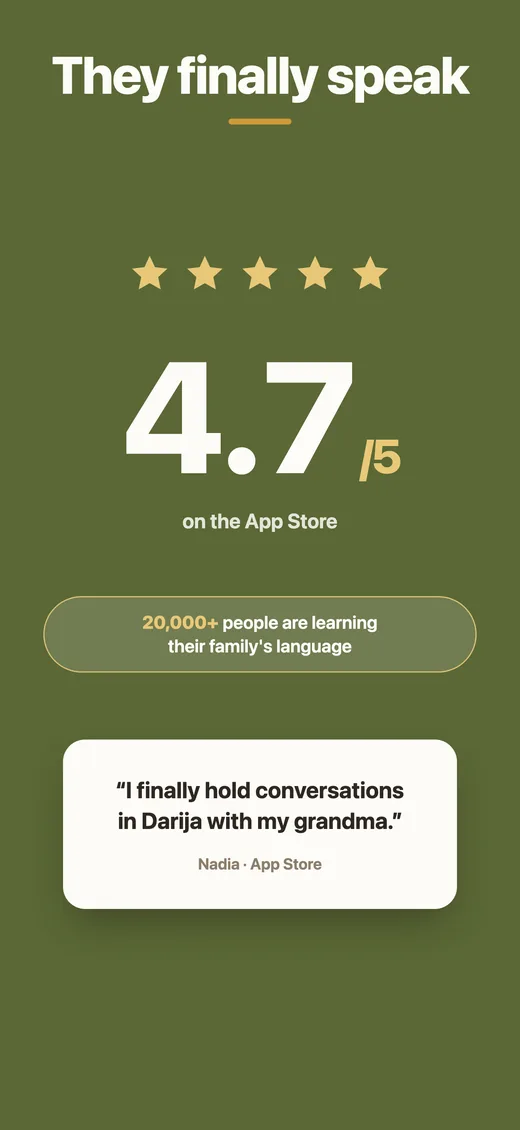
5 minutes a day · Free to start · 4.7/5 on the App Store
On a computer? Try the web app →