Best app to learn Kabyle in 2026
You're looking for an app to learn Kabyle — Taqbaylit, the Amazigh language of Kabylia — and you quickly run into a frustrating fact: Duolingo, Babbel, Rosetta Stone, Busuu… no major platform offers it. For a language spoken by several million people in Algeria and across a huge diaspora — in France above all, but also in Canada, the US and the UK — the digital options are surprisingly thin. This guide takes an honest tour of what actually exists — specialized apps, dictionaries, community resources — and helps you choose based on your goal.
Which app should you use to learn Kabyle? Quick answer (November 2026): Duolingo, Babbel, Rosetta Stone and Busuu don't teach Kabyle or any other Amazigh language. The options are community apps and platforms, Kabyle dictionary apps, dictionaries, songs and YouTube. For the Kabyle spoken at home, a specialized app like Dialect offers the everyday words and phrases, recorded by native Kabyle speakers, in the Kabyle Latin alphabet, with spaced repetition and five-minute sessions on iPhone, Android and the web, free to start. It's made for the Kabyle diaspora and their partners — details below.
Is Kabyle on Duolingo?
No. Duolingo does not teach Kabyle or any other Amazigh (Berber) language (course list checked on November 18, 2026). Babbel, Rosetta Stone and Busuu don't offer it either.
The options are community apps and platforms, Kabyle dictionary apps, songs and YouTube, compared below. Dialect teaches the Kabyle spoken at home, recorded by native Kabyle speakers, in the Kabyle Latin alphabet: learn Kabyle with Dialect.
Why Kabyle needs a dedicated app
Kabyle is an Amazigh language, not an Arabic dialect
First things first, because the confusion is common: Kabyle is not a dialect of Arabic. It is an Amazigh (Berber) language, from a language family present in North Africa long before Arabic arrived. Its grammar, core vocabulary and phonology are its own: "hello" is azul, "thank you" is tanemmirt, "how are you?" is amek telliḍ?. None of that can be derived from Arabic — not from the Standard Arabic of generalist courses, nor from neighboring Algerian Darija. No "Arabic" course of any kind will bring you closer to your grandmother's conversation in Tizi Ouzou.
A script of its own: the Kabyle Latin alphabet (and Tifinagh)
Modern Kabyle is written in an adapted Latin alphabet, enriched with characters that capture its distinctive sounds: ḍ, ṭ, ɣ (the deep "r" of taɣect, the voice), ɛ (the pharyngeal of taɛrabt), ẓ, č, ǧ. It is the script of schools in Kabylia, of publishing and of the online press. Alongside it, Tifinagh, the historic Amazigh alphabet with its geometric letterforms, remains a powerful identity symbol — you'll see it on flags, jewelry and shop signs — but you don't need it to start speaking. A good app must display the Kabyle Latin alphabet correctly, with all its characters: that is far from universal. For the cultural side, see our French-language guide to the Tifinagh alphabet.
A language of family transmission, now under strain
For centuries, Kabyle was passed down mostly orally, from generation to generation. In the diaspora, that chain is stretching thin: you understand your parents but don't dare answer, you sing along to Idir or Aït Menguellet without catching every word, you want your children to hear their grandparents' language. Relearning Kabyle is less about "learning a foreign language" than about reconnecting a thread. That changes the method entirely: you need speech first, family-life vocabulary, and sessions short enough to fit a busy life. That is exactly the subject of our guide to learning your heritage language as an adult.
The 4 criteria of a good Kabyle app
- Audio recorded by real Kabyle speakers — not a synthetic voice. Text-to-speech engines handle under-resourced languages like Kabyle poorly: approximate sounds, artificial accent. Your ear calibrates on what it hears; make sure it hears the real thing.
- Family-life vocabulary first — greetings, family, meals, the village, emotions. You're learning Kabyle to talk to your own people, not to book a hotel room.
- A real memorization system — spaced repetition brings each word back at the optimal moment, just before you forget it. A vocabulary list read once evaporates; a word reviewed at the right time sticks.
- Short sessions and visible progress — 5 minutes a day kept up for 3 months beats an hour every Sunday abandoned in January. Daily streaks, milestones, badges: the app should make consistency easy.
Dialect in practice, with screenshots
Dialect was built precisely for this use case: diaspora members who want to speak their family's language again. Kabyle is treated as a language in its own right, on equal footing with eighteen other rare languages — and it is one of the languages whose audio is entirely recorded by native speakers.
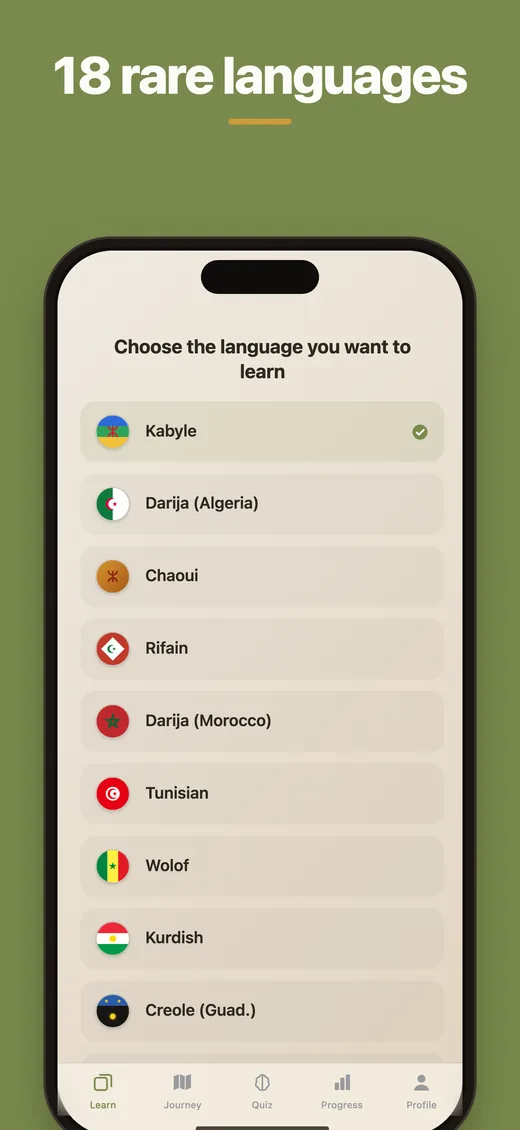
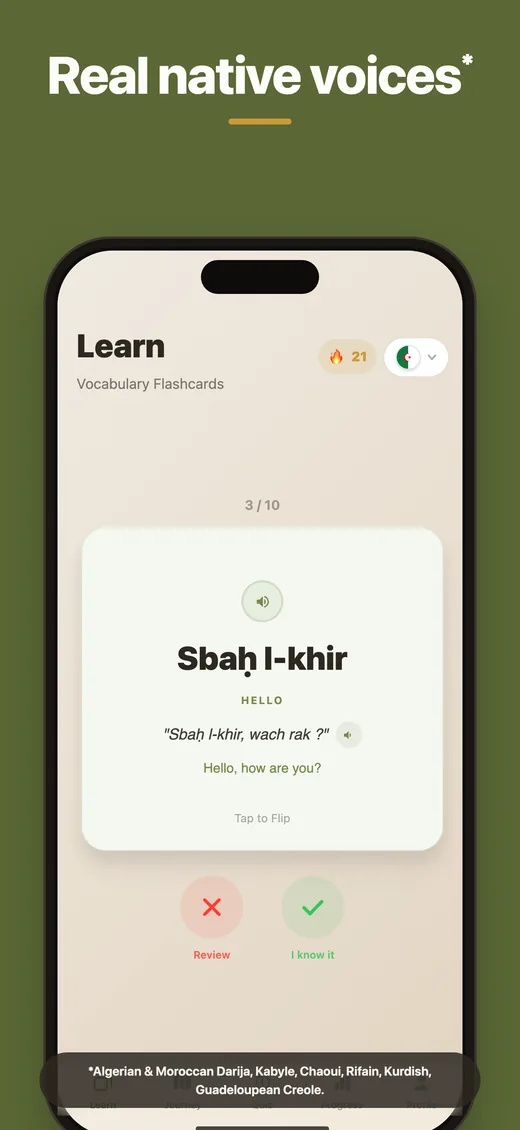
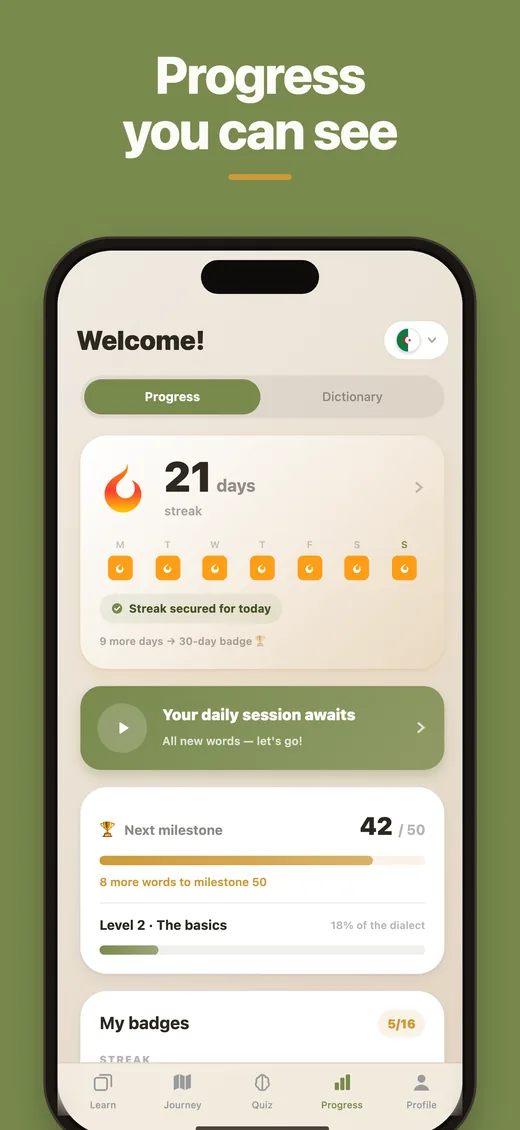
In concrete terms:
- 100% native audio for Kabyle: every word and every example sentence is recorded by real Kabyle speakers, never by text-to-speech. You hear the real ɣ of taɣect, the real ɛ, the emphatic ḍ and ṭ — the way they are pronounced in Kabylia.
- The full Kabyle Latin alphabet: azul, tanemmirt, amek telliḍ? display with their real characters, not approximations.
- Flashcards, quizzes and level-based tracks with spaced repetition: easy words space out, hard ones come back.
- 5-minute sessions, daily streaks, milestones (50, 100, 200 words…): built to fit a busy life.
- Free to start, on iPhone, Android and the web.
An honest comparison of the alternatives
The Kabyle ecosystem owes a lot to community and non-profit projects built with modest means — they deserve respect. Here is the real landscape in 2026:
The table is sorted by type of solution (major platforms, dedicated apps, courses, free resources), then alphabetically. Dialect, which publishes this guide, sits in its place like the others.
| Solution | Strengths | Limits for learning Kabyle |
|---|---|---|
| Duolingo / Babbel / Rosetta Stone / Busuu | Proven methods, huge catalogs | Do not offer Kabyle — or any Amazigh language. That gap is what this guide documents |
| Community apps and platforms | Community-run projects, some aimed specifically at diaspora children | Coverage, availability (often Android only) and memorization tracking vary from project to project |
| Dialect | 100% native Kabyle audio (words + sentences), full Kabyle Latin alphabet, spaced repetition, 5-min sessions, designed for the diaspora, on iPhone, Android and web | No formal grammar course |
| Kabyle dictionary apps | Dedicated apps with thousands of words and phrases, built on reference dictionaries | Closer to an illustrated dictionary than a course; check that the review rhythm and progression match how you learn |
| Dictionaries and lexicons (Amawal, Dallet…) | Precious references; the Amawal, heir to Mouloud Mammeri's work, enriched Kabyle with many neologisms | These are reference works, not methods: indispensable as backup, insufficient for learning to speak |
| YouTube, songs, podcasts | Free, real immersion, an immense musical heritage (Idir, Aït Menguellet, Lounès Matoub…) | No structure and no review system: perfect as a complement, insufficient on its own for durable memorization |
Offerings checked in November 2026.
Which solution for your profile?
- You're from the diaspora and want to talk with family: Dialect, starting with greetings and family vocabulary. Add calls back home — the best and most moving practice lab there is.
- You understand Kabyle but don't dare speak it: your ear is already trained; what you lack is active vocabulary. Dialect's quizzes and spaced repetition are built to turn passive understanding into spoken sentences.
- You want to go deeper into grammar and writing: combine a daily speaking app with a textbook or structured course (Kabyle cultural associations, online classes), and keep a reference dictionary at hand.
- You're drawn to Amazigh culture first: start with our free guides — which Berber language to learn and the Tifinagh alphabet (both in French) — then choose your variety knowingly.
The method that works, whatever the app
An app is not everything: method is what makes you progress. Here is the one we recommend — and that Dialect orchestrates automatically:
- 5 to 10 minutes a day, every day. Consistency beats intensity, with no known exception in the research.
- Audio from day one. Listen to each word several times, repeat out loud — ɣ and ɛ can only be learned by pronouncing them, even alone in your kitchen.
- Trust the reviews. When a word comes back just as you thought you knew it, that is exactly when your memory needed it.
- Speak before you feel ready. From 50 words on, drop azul, tanemmirt and amek telliḍ? into a family call. The smiles you'll get are worth all the badges.
Frequently asked questions
What is the best app to learn Kabyle?
Check four things: words recorded by native Kabyle speakers, everyday Kabyle rather than another Amazigh language, spaced repetition, and the Kabyle Latin alphabet. As of November 2026, Duolingo and Babbel don't teach Kabyle; community apps, dictionaries and classes are the other options. Dialect teaches everyday Taqbaylit with native voices, in five-minute sessions, free to start.
Is Kabyle a dialect of Arabic?
No. Kabyle (Taqbaylit) is an Amazigh (Berber) language, a language family distinct from Arabic, spoken in North Africa long before Arabic arrived. Its grammar, core vocabulary and sounds are its own. Mistaking it for an Arabic dialect is a common error — and a bad starting point for learning it.
Do you need to learn the Tifinagh alphabet to learn Kabyle?
No. Tifinagh is the historic, emblematic alphabet of the Amazigh languages, but everyday Kabyle is written in an adapted Latin alphabet (ḍ, ṭ, ɣ, ɛ…). That is the script used by schools in Kabylia, by publishers, and by Dialect. You can discover Tifinagh later, out of curiosity or cultural attachment.
How long until you can hold a simple conversation in Kabyle?
With 5 to 10 minutes a day, count on 2 to 3 months for simple exchanges: greetings, family news, meals. The decisive factor is not talent — it's consistency.
Is Dialect's Kabyle audio really native?
Yes. Kabyle words and example sentences are recorded by real Kabyle speakers, never by text-to-speech. That is essential for acquiring the real pronunciation of sounds like ɣ, ɛ, ḍ or ṭ — and it's the #1 criterion we advise you to check everywhere else.
5 minutes a day · 100% native audio · 4.7/5 on the App Store
On a computer? Try the web app →