What is Tunisian Arabic (Derja)?
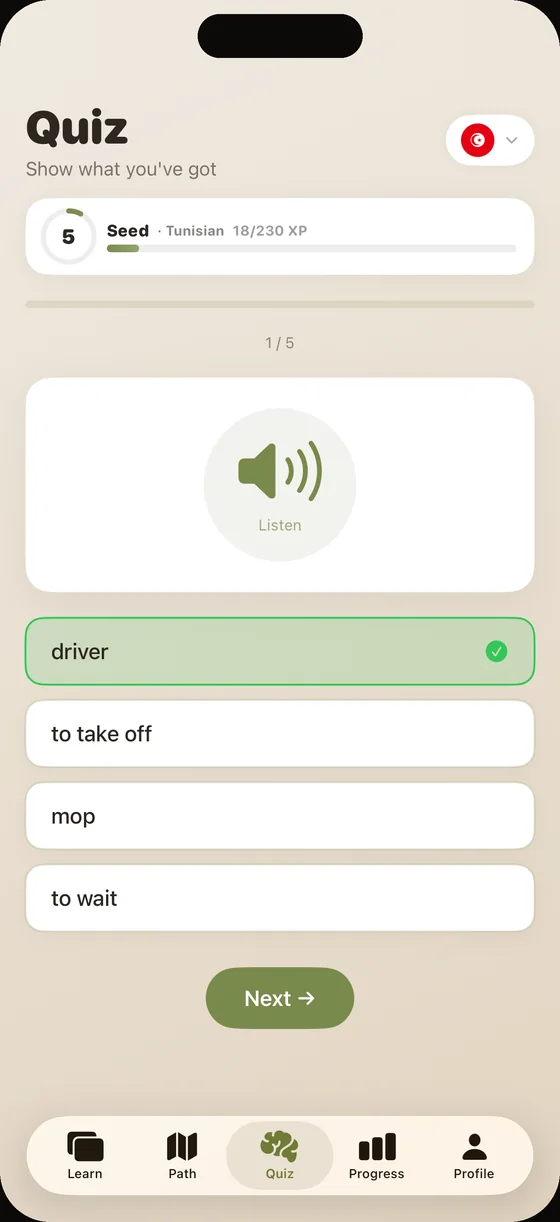
Tunisian Arabic, called Derja in Tunisia, is the everyday spoken language of the country. It is a Maghrebi Arabic dialect with borrowings from Berber, Italian, Turkish, French and Spanish, and it differs a lot from the Modern Standard Arabic taught at school and in most apps. Dialect teaches it from English, with every word recorded by a native speaker.
Which app should you use to learn Tunisian Arabic?
As of November 2026, no major platform teaches Tunisian: Duolingo's Arabic course is Modern Standard Arabic, Babbel has no Arabic, and uTalk's five Arabic varieties leave it out. Specialized apps, online teachers and YouTube fill the gap. For the Derja spoken at home, a specialized app like Dialect gives you the everyday words and phrases, recorded by Asma, a native speaker, in Latin letters, with spaced repetition and five-minute sessions on iPhone, Android and the web. It's free to start and made for the Tunisian diaspora and partners.
For apps, courses and tutors side by side, see how to choose an app to learn Tunisian Arabic.
Why learn Tunisian?
Tunisian derja (ed-derja) is shaped by an exceptionally rich layered history — Punic Carthage, Berber substrate, Arab waves, Ottoman period, French colonization, Italian immigration. Learning Tunisian means accessing a language that captures all these influences in a single tongue.
Whether you are part of the diaspora or simply passionate about world languages, Dialect gives you the tools to progress quickly.
The Dialect Method
Our app combines playful learning with linguistic rigor:
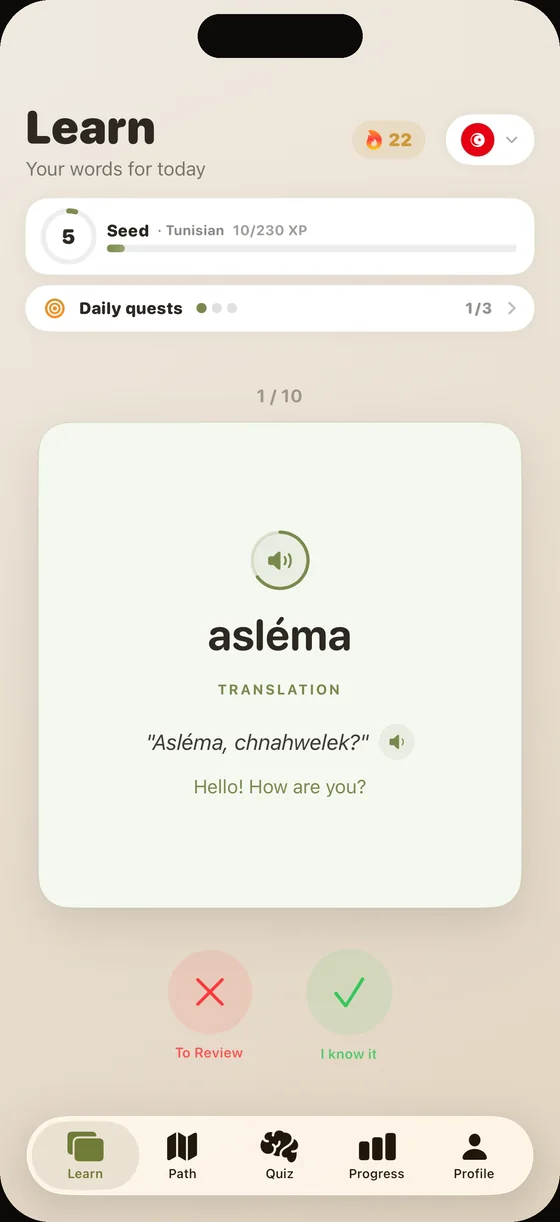
- Essential vocabulary: learn the words most used in everyday life.
- Native audio: hear the exact pronunciation on every word.
- Interactive quizzes: test your knowledge and track your progress.
- Review mode: never lose what you've already learned.
The Science Behind Dialect
Dialect is built on well-tested findings from cognitive science:
- Spaced Repetition System (SRS): our algorithm calculates the optimal time to review each word, right before you would forget it.
- Pure auditory immersion: native audio on every word, tuned for Tunisian derja.
- Small steps: each language is split into short units, so you never feel overloaded.
Tunisian in a few facts
- Language family: Maghrebi Arabic, with borrowings from Berber, Italian, Turkish, French and Spanish.
- Speakers: 11 to 12 million speakers.
- Main regions: Tunisia, with diaspora in France, Italy and Germany.
- Writing systems: Arabic script, plus Latin alphabet in digital communications (arabizi).
Tunisian Arabic shows the strongest Italian lexical presence among all Maghrebi varieties (cuisine, maritime, daily life). It has no official status but remains the language of daily life, popular media and artistic creation.
10 everyday Tunisian words
The vocabulary people actually use at home or at the market. The right-hand column gives the full sentence in Tunisian, exactly as it appears in the app.
| English | Tunisian | Example |
|---|---|---|
| water | ma | Ochrob ma. |
| to eat | yékel | Koul bel béhi. |
| to drink | Ochrob | Ochrob el ma. |
| home | dar | Ena fil dar. |
| mother | ommi | Ommi fi dar. |
| father | baba | Baba fi dar. |
| child | tfol | Etfol fel dar. |
| money | flous | Ma 3andouch flous. |
| market | sou9 | Nechri mel sou9. |
| tomorrow | ghodwa | Ghodwa nektbou. |
Tunisian is commonly written in the Latin alphabet, using digits for sounds Latin script lacks: 3 for ع, 7 for ح, 9 for ق. It also carries Italian and French loanwords that learners spot immediately.
How Dialect makes learning Tunisian easier
Learning a heritage language when you live in the diaspora has unique challenges: few structured resources, materials often aimed at linguists rather than daily learners, and a critical shortage of reliable audio recordings. Dialect was built to address these obstacles.
Specifically for Tunisian, the app provides:
- Progress by frequency of use: you first learn words and phrases you will actually hear.
- 100% native recordings: authentic accent from session one.
- Short sessions (5 cards a day): consistency beats intensity.
- Smart review: the spaced repetition algorithm presents each word right before you would forget it.
Hello, thank you and essential phrases in Tunisian
Looking to say hello in Tunisian, thank you or how are you? Here are the must-know greetings and polite forms:
| English | Tunisian |
|---|---|
| Hello | asléma |
| Thank you | 3aychek |
| Yes | ih |
| No | lé |
| Goodbye | bessléma |
| Sorry | séma7ni |
| Please | brabbi |
Frequently asked questions about learning Tunisian
What is the best app to learn Tunisian Arabic?
Check four things: words recorded by native Tunisian speakers, real Derja rather than Modern Standard Arabic, spaced repetition, and Derja in Latin letters so you can read it from day one. As of November 2026, no major platform teaches Tunisian: Duolingo's Arabic is Standard Arabic and Babbel has none. Specialized apps and online teachers are the other options. Dialect teaches everyday Tunisian with Asma's native voice, in five-minute sessions, free to start.
How do you say hello in Tunisian?
In Tunisian Arabic (Derja), "hello" is "a7la" or "sba7 el5ir" (good morning). In an informal setting you can also say "aslama". Hear the exact pronunciation in the Dialect app.
How long does it take to learn the basics of Tunisian?
With Dialect, practicing 5 to 10 minutes a day, you can master essential Tunisian vocabulary in 4 to 6 weeks.
Is the Dialect app free?
Dialect is free to start: every day you get one session, one quiz and the Greetings lesson of the Path. Premium unlocks everything.
Does the Dialect app include audio for Tunisian?
Yes, every Tunisian word comes with native audio in the app to help you memorize the pronunciation.
Do I need to know any Arabic to start?
No. Dialect is designed for complete beginners.
Is Dialect available on Android?
Yes. The app is on Google Play. On desktop, Dialect runs directly in your browser through the web app (mydialect.io/app): same languages, same native audio, same account. The native app is available on iPhone and iPad from the App Store.
What is Tunisian Arabic called?
In Tunisia it is simply called Derja (also spelled Darja or Darija), or Tounsi (“Tunisian”). In English you will see Tunisian Arabic, Tunisian Derja or just Tunisian.
Can you learn Tunisian Arabic online for free?
You can start for free. Dialect's free plan gives you one session and one quiz a day, plus the Greetings lesson, on iPhone, Android or in your browser. To compare apps, tutors and free resources, read our guide on how to learn Tunisian Arabic.
Learning Tunisian: the essentials
Neither Duolingo, nor Babbel, nor Memrise offers a Tunisian course. uTalk, which sells five varieties of Arabic, does not have Tunisian either. That leaves a handful of private tutors: the offering is thin. Dialect covers the everyday words and phrases of Tunisian, each with audio in the voice of Asma, a native speaker, grouped by theme and reviewed with spaced repetition. The app is free for one session per day per language, on iPhone, iPad, Android and the browser.
Discover other languages on Dialect
Dialect offers many heritage languages to reconnect with your roots:
Start for free, today
Free daily session. On iPhone via the App Store, on Android via Google Play, or straight in the browser on desktop.

 Scan with your phone · iPhone or Android
On a computer?
Open the web application