Best app to learn Bambara in 2026

You're looking for an app to learn Bambara — Bamanankan, the great lingua franca of Mali — and you quickly run into the problem: generalist platforms like Duolingo and Babbel simply don't offer it. For a language spoken or understood by tens of millions of people across West Africa, digital resources remain surprisingly scarce: a few university courses, some enthusiasts' websites, scattered videos. This guide takes an honest tour of what actually exists in 2026, and helps you choose based on your profile.
Which app should you use to learn Bambara? Quick answer (November 2026): Duolingo, Babbel and Rosetta Stone don't teach Bambara or any Manding language. The options are multi-language African apps, small specialized apps, Manding websites, the INALCO program in Paris and YouTube. To build everyday vocabulary, a specialized app like Dialect offers the essential words and phrases in Mali's official Latin spelling, recorded by a native speaker from Mali, plus spaced repetition and five-minute sessions on iPhone, Android and the web, free to start. It's made for Malian families and their partners — details below.
This page compares the tools that exist for Bambara. If you have already made up your mind, go straight to learn Bambara with Dialect: everyday words and example sentences in the official spelling.
Is Bambara on Duolingo?
No. Duolingo does not teach Bambara (course list checked on November 18, 2026), and neither do Babbel or Rosetta Stone. No major language-learning platform offers Bambara or any other Manding language.
What does exist is compared below: multi-language African apps, small specialized apps, Manding websites, the INALCO program in Paris and YouTube. Dialect teaches everyday Bambara in Mali's official Latin spelling, with a native voice from Mali on nearly all the words and their example sentences: learn Bambara with Dialect. New to the language? Start with our guide to the Bambara language.
Why Bambara needs a dedicated app
A major lingua franca… ignored by the major platforms
In Mali, Bambara is far more than a regional language: it is the language of Bamako, of trade, of radio, of music — the one that lets speakers of dozens of different mother tongues understand each other. It belongs to the Manding continuum (Mande language family, part of the wider Niger-Congo group), which gives it a considerable bonus: by learning Bambara, you will understand most of the Dioula spoken in Côte d'Ivoire and Burkina Faso, and a good part of Maninka. One language learned, three countries where you can make yourself understood. Despite all this, no major platform teaches it: Bambara remains the business of specialized resources.
A Manding language, far from familiar reference points
Bambara resembles nothing you learned at school. The sentence is built differently: the object comes before the verb (n bɛ bamanankan kalan, literally "I [am] Bambara learning"). It is also a tonal language: the pitch of your voice distinguishes words that are otherwise identical on paper. And its culture of greeting is a world of its own: i ni ce — which serves as both hello and thank you — literally means "you and the work", an acknowledgment of the other person's effort. You then ask i ka kɛnɛ wa? ("are you well?"), then for news of the family, in an almost ritual order. A generalist app calibrated on Spanish or English cannot render any of this; you need content designed for Bambara.
An accessible Latin script, with four letters to tame
Good news for beginners: Bambara is officially written in the Latin alphabet, following a spelling standardized in Mali. No whole new alphabet to memorize before reading your first sentence. Only four letters go beyond a standard keyboard: ɛ (an open e, as in "bet"), ɔ (an open o, as in "thought"), ɲ (like the "ny" in "canyon") and ŋ (like the "ng" in "song"). You meet them from your very first words — kɛnɛ (healthy), ɲɔ (millet) — and get used to them within days. The app still has to display them correctly and get you accustomed to them from the start, instead of improvising rough transcriptions.
The 4 criteria of a good Bambara app
- Everyday vocabulary first — greetings, family, food, the market. Greetings above all: in Bambara they open every exchange and vary with the time of day (i ni sɔgɔma in the morning, i ni su in the evening). An app that starts with "the airport" misses the language.
- Accessible, correct writing — Mali's official Latin spelling, with the characters ɛ, ɔ, ɲ, ŋ displayed properly and introduced gradually. Neither rough approximate transcription, nor linguists' jargon.
- A real memorization system — spaced repetition brings each word back at the optimal moment before you forget it. Without it, much of what you study is quickly forgotten.
- Short sessions and visible progress — 5 minutes a day kept up for 3 months beats an hour every Sunday abandoned in January. The app should make consistency easy (streaks, milestones, reminders).
Dialect in practice, with screenshots
Dialect was built precisely for this use case: diaspora members and spouses who want to speak the family's language (again). Bambara is treated as a language in its own right, with its official spelling and its everyday vocabulary — not as a curiosity relegated to the back of a catalog.
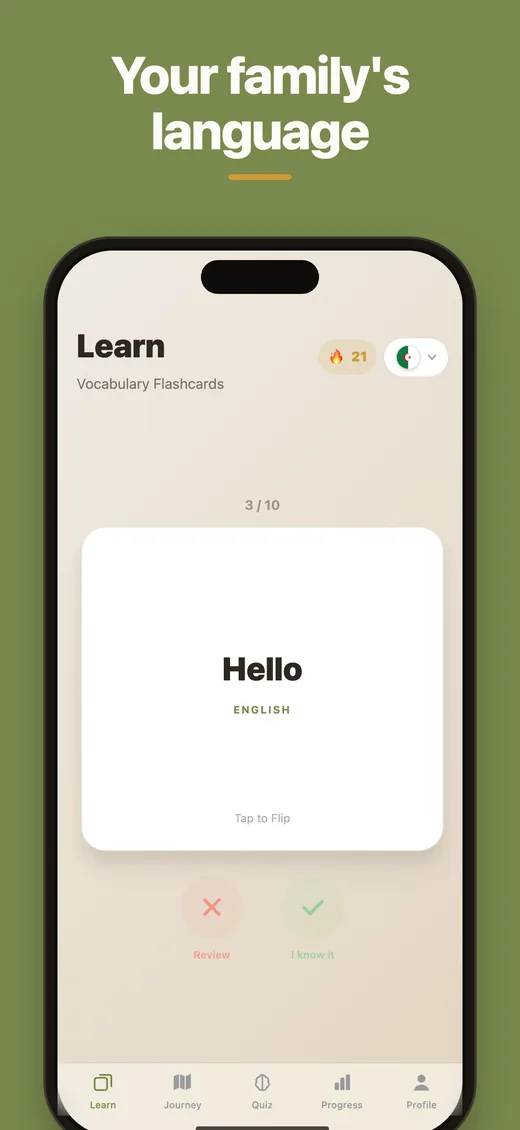
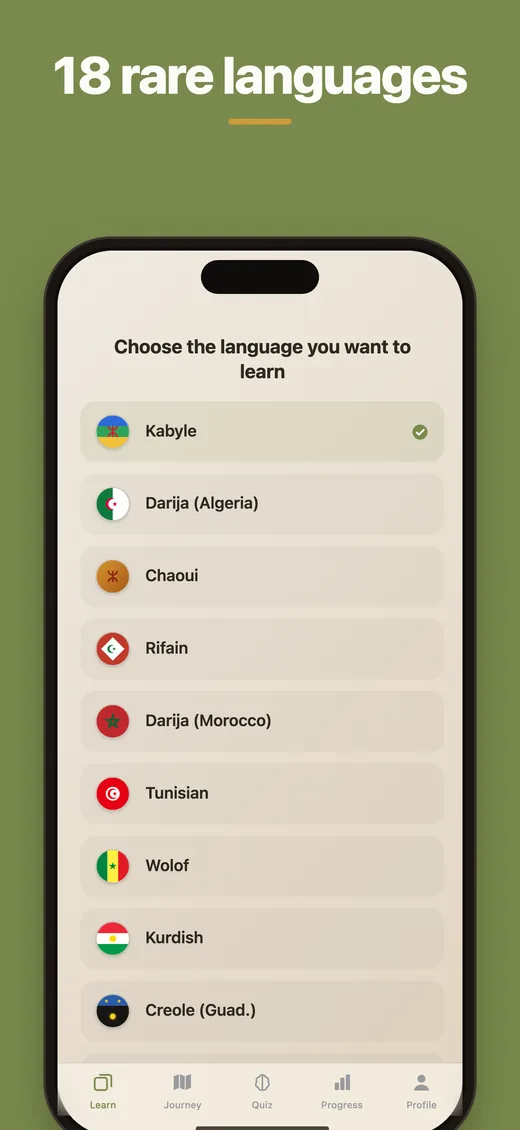
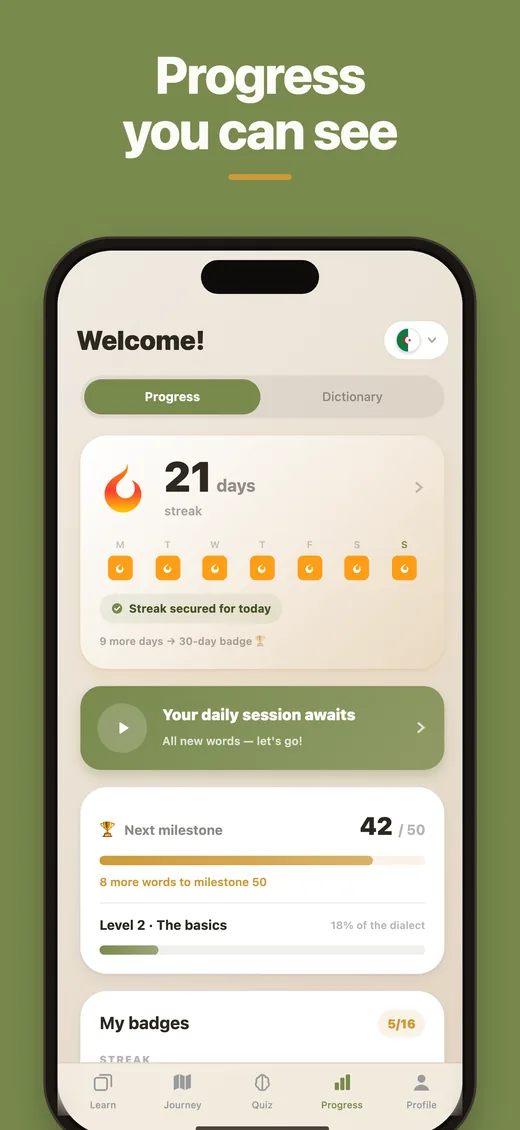
In concrete terms, for Bambara:
- Flashcards, quizzes and level-based tracks with spaced repetition: easy words space out, hard ones come back until they stick.
- The official Latin spelling: i ni ce, i ka kɛnɛ wa?, dɔɔni dɔɔni (little by little) — the characters ɛ, ɔ, ɲ displayed correctly and introduced gently.
- Everyday life first: greetings, family, food, the market — the vocabulary that serves you from the very first call back home.
- 5-minute sessions, daily streaks, milestones (50, 100, 200 words…) and badges: built to fit a busy life, with visible progress.
- Free to start, on iPhone, Android and the web.
One piece of advice that holds for any method: feed your ear in parallel. Listen to the speakers around you — family remains the best pronunciation teacher —, to Malian music (Oumou Sangaré, Salif Keïta, Amadou & Mariam sing largely in Bambara) or to native speakers' videos on YouTube. The app builds vocabulary and memory; the ear is trained on real voices.
An honest comparison of the alternatives
No solution is perfect for everyone. Here is the real landscape in 2026:
The table is sorted by type of solution (major platforms, dedicated apps, courses, free resources), then alphabetically. Dialect, which publishes this guide, sits in its place like the others.
| Solution | Strengths | Limits for Bambara |
|---|---|---|
| Duolingo / Babbel / Rosetta Stone | Proven methods, huge catalogs | Do not offer Bambara, or any Manding language — the fate of most African lingua francas |
| Dialect | Flashcards, quizzes and level-based Bambara tracks, a native voice from Mali, official Latin spelling, spaced repetition, 5-min sessions, designed for the diaspora, on iPhone, Android and web | No formal grammar course |
| Multi-language African apps | Several African languages in one app, short lessons | Very broad catalog: check how many words and sentences exist for your language, and what stays available without a subscription |
| Small specialized apps | Focused on Bambara, themed vocabulary lists | Coverage and memorization tracking vary from app to app; reviews rarely scheduled over time |
| Specialized Manding websites | Introductory videos and podcast, online Bambara/Dioula dictionary, one-on-one video lessons with a specialist teacher | Excellent for grammar and reference, but no mobile app for daily memorization; private lessons billed by the hour |
| INALCO (Paris) | Multi-year university program in Manding, teachers who are linguists and native speakers, a published reference grammar | Demanding academic format: pace, attendance and presence in Paris; out of proportion if the goal is talking with family |
| YouTube / Malian music | Free, real immersion in the living language, Malian artists and creators | No structure and no review system: perfect as a complement for the ear, insufficient on its own for durable memorization |
Offerings checked in November 2026.
Which solution for your profile?
- You're from the Malian diaspora and want to talk with family: Dialect, starting with greetings and family vocabulary. Add calls back home and conversations with the elders — the best practice lab there is, and the finest encouragement.
- You're moving to Mali, Côte d'Ivoire or Burkina Faso to live or work: Dialect for the everyday vocabulary foundation, plus a structured Manding resource for grammar. The Bambara you learn for Bamako will serve you well beyond Mali's borders.
- You're aiming for an academic level (reading, analyzing, teaching): the Manding program at INALCO in Paris is the reference, and a vocabulary app remains a good training companion alongside it.
- You just want a few phrases before a trip or a wedding: our free guides (how to say hello in 15 languages) and a week or two of Dialect cover greetings and polite phrases — and in Bambara, greeting people well is already half the conversation.
The method that works, whatever the app
An app is not everything: method is what makes you progress. Here is the one we recommend — and that Dialect orchestrates automatically:
- 5 to 10 minutes a day, every day. Consistency beats intensity, with no known exception in the research.
- Greetings first. I ni sɔgɔma, i ka kɛnɛ wa?, i ni ce: these formulas open every door and are reused in every exchange. Master them before anything else.
- Trust the reviews. When a word comes back just as you thought you knew it, that is exactly when your memory needed it.
- Expose your ear to native speakers. Family, Malian music, YouTube videos: Bambara is a tonal language, and tones are caught by immersion, by listening and repeating out loud.
- Speak before you feel ready. From 50 words on, drop i ni ce into a family call. As the Bambara proverb goes: dɔɔni dɔɔni — little by little.
Frequently asked questions
Are Bambara and Dioula the same language?
They are two very close varieties of one continuum, Manding. Bambara (Bamanankan) is the variety of Mali, Dioula that of Côte d'Ivoire and Burkina Faso, and Maninka a third branch spoken from Guinea to Senegal. Mutual understanding is largely possible: by learning Bambara, you will understand most Dioula, with differences in accent and vocabulary.
Do you need to know the characters ɛ, ɔ, ɲ to start?
No, and that is good news: Bambara is officially written in the Latin alphabet. Only four letters go beyond the standard alphabet — ɛ (an open e), ɔ (an open o), ɲ (like the "ny" in "canyon") and ŋ (like the "ng" in "song") — and you tame them within a few days of practice. There is no whole new alphabet to memorize before reading your first sentences.
How long does it take to hold a simple conversation?
With 5 to 10 minutes a day, count on 2 to 3 months for simple exchanges: greetings, family news, the market. Bambara greetings, highly codified, make an excellent starting point: they are reused as-is in every conversation. The decisive factor is not talent — it's consistency.
What is the best app to learn Bambara?
Check four things: the Bambara actually spoken in Mali, Mali's official Latin spelling, spaced repetition, and audio if you need to train your ear. As of November 2026, Duolingo and Babbel don't teach Bambara; dictionaries, Manding websites, INALCO and tutors are the other options. Dialect offers everyday words and phrases recorded by a native speaker from Mali, in five-minute sessions, free to start.
Does Dialect have audio for Bambara?
Yes. In Dialect, Bambara is recorded by a native speaker from Mali: almost all the words and their example sentences can be played. Bambara is a tonal language, so keep listening to speakers too: family, Malian radio, Bambara-speaking creators.
5 minutes a day · Free to start · 4.7/5 on the App Store
On a computer? Try the web app →