Best app to learn Vietnamese in 2026

You're looking for an app to learn Vietnamese — to talk with your grandparents, prepare a trip to Hanoi, or reconnect with your family's language. Good news: unlike many so-called "rare" languages, Vietnamese is available on several big platforms. Duolingo offers a Vietnamese course, taught from English, and so does Mondly. But these are general courses, built around a standard syllabus — while what the diaspora wants first is the language of family meals and greetings to the elders. This guide takes an honest tour of what exists in 2026, and answers the real question: which one should you choose based on your profile?
Which app should you use to learn Vietnamese? Quick answer (November 2026): Duolingo (from English only) and Mondly teach Vietnamese; Memrise has no official course, only word lists made by its users. Tutors, multi-language apps and YouTube complete the picture. For the Vietnamese of family life, a specialized app like Dialect offers the everyday words and phrases in Northern (Hanoi) Vietnamese, with clear audio, spaced repetition and five-minute sessions on iPhone, Android and the web, free to start. It's made for heritage learners and partners of Vietnamese families — details below.
This page compares the tools that exist for Vietnamese. If you have already made up your mind, go straight to learn Vietnamese with Dialect: the words of family and everyday life, with clear audio.
Is Vietnamese on Duolingo?
Yes. Duolingo teaches Vietnamese, from English only (course list checked on November 18, 2026). It is a long, structured general course and a serious option. Mondly also teaches Vietnamese; Memrise has no official course.
What a specialized app adds: the vocabulary of family life first, in Northern (Hanoi) Vietnamese, with clear audio, spaced repetition and five-minute sessions, designed for heritage learners and partners of Vietnamese families. The two approaches complement each other: learn Vietnamese with Dialect.
Why Vietnamese demands a tailored approach
A tonal language: six tones in the North, and it's less scary than it sounds
Vietnamese is a tonal language: the pitch and melody of your voice change the meaning of the word. The Northern variety, the one spoken in Hanoi, distinguishes six tones — the classic example is the syllable ma, which can mean "ghost" (ma), "mom" (má), "but" (mà), "grave" (mả), "horse" (mã) or "young rice seedling" (mạ) depending on the tone. Put like that, it can be intimidating. In practice, two things are quickly reassuring: each tone is written down (the accent on the vowel tells you exactly how to pronounce it), and the ear gets used to it through repeated listening. You don't learn tones from a chart: you catch them by hearing the same words dozens of times, like a melody that ends up sticking. That is exactly what a good app should organize.
Quốc ngữ: a Latin script, with a nod to French history
Unlike Chinese or Thai, Vietnamese is written in a Latin alphabet: the quốc ngữ, devised by European missionaries in the 17th century and generalized in the early 20th. That's a considerable advantage: you can already read cảm ơn (thank you) or xin chào (hello); all that remains is to learn what the diacritical marks are telling you — the tones and a few extra vowels like ơ or ư. Vietnam's shared history with France also left traces in the vocabulary: cà phê (coffee, from café), ga (train station, from gare), xà phòng (soap, from savon). So many little bridges that make the language less foreign than you might think.
Anh, chị, em: Vietnamese politeness lives in the pronouns
The cultural heart of Vietnamese is neither in the tones nor in the script: it is in how you address people. There is no plain "you": you position yourself by age and relationship. Anh for a man slightly older than you, chị for a slightly older woman, em for someone younger, ông and bà for grandparents and elders. A grandchild greeting their grandmother says cháu chào bà ạ — with the little respectful ạ at the end, very typical of Northern speech. Getting the pronoun wrong isn't a grammar mistake: it's a social misstep. An app designed for family life must teach these usages from the very first lessons, not relegate them to chapter 12.
The 4 criteria of a good Vietnamese app
- Learning that goes through the ear — in a tonal language, reading without listening is useless. Demand audio on every word and every sentence, and listen several times before repeating.
- Family and everyday vocabulary first — greetings to the elders, meals, family, the market. Not "the conference room" in lesson 2: if you're learning Vietnamese, it's most often to talk to the people who matter.
- A real memorization system — spaced repetition brings each word back at the optimal moment before you forget it. Without it, you retain a fraction of what you study, tones included.
- Short sessions and visible progress — 5 minutes a day kept up for 3 months beats an hour every Sunday abandoned in January. The app should make consistency easy (streaks, milestones, reminders).
Dialect in practice, with screenshots
Dialect was built for one precise use case: diaspora members and spouses who want to speak the family's language (again). Vietnamese is taught in its Northern (Hanoi) variety, the country's standard reference.
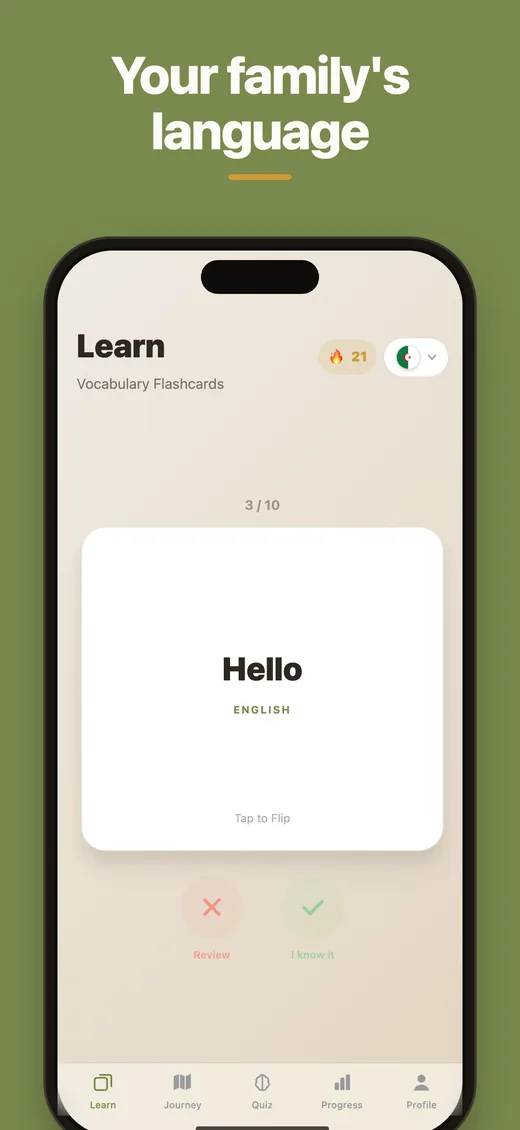
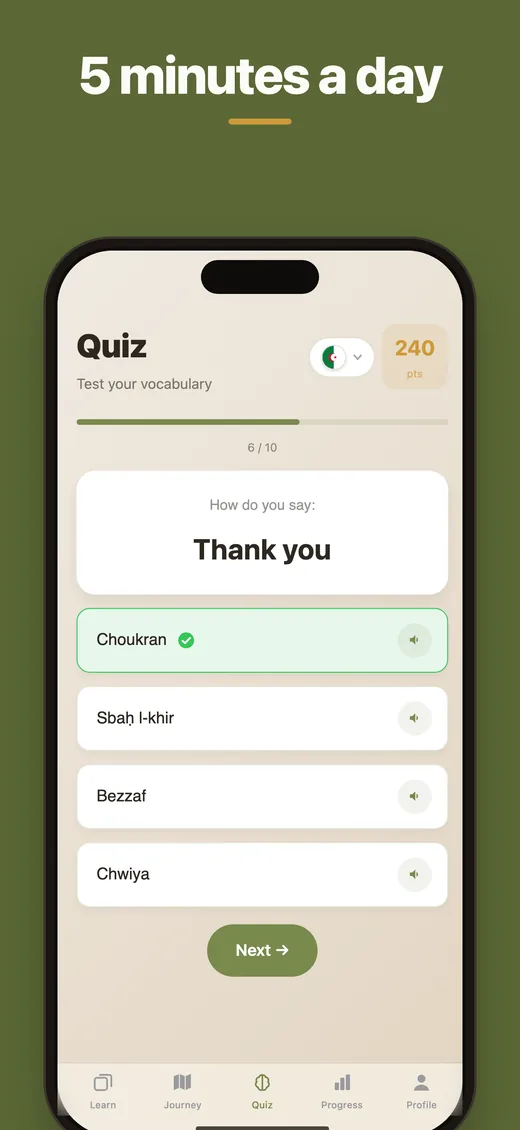
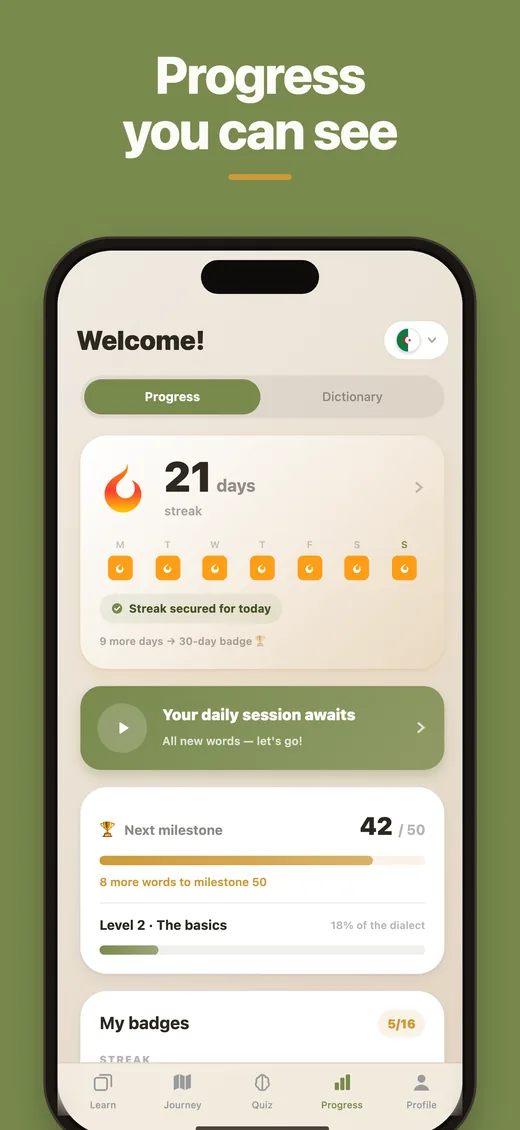
In concrete terms:
- Clear audio on every word and every sentence, with a Northern accent. You hear the six Northern tones cleanly and consistently, which is precisely what your ear needs to calibrate at the start.
- Family vocabulary first: xin chào, cảm ơn, khỏe không? (how are you?), the pronouns anh, chị, em, the meals — what people actually say around a table.
- Flashcards, quizzes and level-based tracks with spaced repetition: mastered words space out, hard ones come back.
- 5-minute sessions, daily streaks, milestones (50, 100, 200 words…): built to fit a busy life.
- Free to start, on iPhone, Android and the web.
An honest comparison of the alternatives
No app is perfect for everyone — and for Vietnamese, several big platforms have genuine arguments. Here is the real landscape in 2026:
The table is sorted by type of solution (major platforms, dedicated apps, courses, free resources), then alphabetically. Dialect, which publishes this guide, sits in its place like the others.
| Solution | Strengths | Limits depending on your goal |
|---|---|---|
| Duolingo | A real Vietnamese course taught from English, long and structured, with a free version (November 2026); game mechanics that keep many learners going | A one-size-fits-all course built for general learners rather than heritage speakers; the heavily gamified universe doesn't suit everyone |
| Mondly | Vietnamese available, short daily lessons, varied exercises | The same themes across the dozens of languages in the catalog, travel-oriented rather than built around the diaspora's family vocabulary |
| Dialect | Family and everyday vocabulary, Northern (Hanoi) variety, clear audio on every word and every sentence, spaced repetition, 5-min sessions, designed for the diaspora | No formal grammar course; iPhone, Android and web |
| Memrise, user-made word lists (back in the app in 2026) | Flexible flashcards with spaced repetition | No official Vietnamese course: only lists made by other users, whose coverage varies from one to the next; little progression structure |
| Multi-language apps (Ling…) | A broad catalog of dozens of languages, Vietnamese included, with writing and pronunciation exercises | Subscription for most of the content (November 2026); a generalist approach, not designed for the family context of the diaspora |
| YouTube / podcasts | Free, real immersion, excellent Vietnamese and diaspora creators | No structure and no review system: perfect as a complement, insufficient on its own for durable memorization — especially for the tones |
Offerings checked in November 2026.
Which solution for your profile?
- You're from the diaspora and want to talk with family: Dialect, starting with greetings, the politeness pronouns and the vocabulary of meals. Add family conversations — the best practice lab there is, and the most forgiving.
- Your family comes from the South of Vietnam — as is the case for many families who left in the 1970s and 80s: know that Dialect teaches the Northern variety. Most of the vocabulary and structures are shared, and Hanoi speech is understood everywhere; but some words and the pronunciation of a few sounds differ from what you hear at home. Be aware of it, and let your relatives give you the local color.
- You're aiming for a long, gamified course: Duolingo's Vietnamese course, taught from English, is a serious option. Add a speech-focused spaced-repetition tool if you want to anchor the tones.
- You're moving to Vietnam to live or work: Dialect for the everyday spoken foundation, plus a structured course (online or at an institute) for grammar and writing.
- You just want a few phrases before a trip: our free guides (how to say hello in 15 languages) and a week or two of Dialect cover the basics of politeness — xin chào, cảm ơn, and the smile that goes with them.
The method that works, whatever the app
An app is not everything: method is what makes you progress. Here is the one we recommend — and that Dialect orchestrates automatically:
- 5 to 10 minutes a day, every day. Consistency beats intensity, with no known exception in the research.
- Audio from day one. In a tonal language, this is non-negotiable: listen to each word several times, repeat out loud imitating the melody — even alone in your kitchen.
- Read the accents like a musical score. The quốc ngữ tells you everything: má rises, mà falls. Always pair what you hear with what you read, and the diacritics will become your allies.
- Trust the reviews. When a word comes back just as you thought you knew it, that is exactly when your memory needed it.
- Speak before you feel ready. From 50 words on, drop a cháu chào bà ạ into a family call or a cảm ơn at your local Vietnamese restaurant. The smiles you'll get are worth all the badges.
Frequently asked questions
What is the best app to learn Vietnamese?
It depends on your goal. Duolingo (from English only) and Mondly teach Vietnamese (November 2026), and Memrise has only word lists made by its users. For family conversation, check for clear audio that makes the tones easy to hear, everyday vocabulary, spaced repetition and short daily sessions. Dialect focuses on everyday Vietnamese, with clear audio, in five-minute sessions, free to start.
Does Dialect teach Northern or Southern Vietnamese?
Northern — the Hanoi variety, which serves as Vietnam's standard reference (media, school, administration). If your family comes from the South, most of the vocabulary and structures remain shared: you will be understood everywhere, even though some words and a few sounds differ from what you hear at home.
Are the tones impossible to learn?
No. The six Northern tones are acquired through repeated listening, not through theory: by hearing the same words well pronounced again and again, the ear associates the tone with the word like a melody. And the writing works in your favor: each tone is marked in black and white by an accent on the vowel.
Do you need to learn a new alphabet?
No. Vietnamese is written in a Latin alphabet (the quốc ngữ): you already know how to read; all that remains is to tame the diacritics that note the tones and a few vowels. That is a huge advantage compared to Chinese or Thai.
How long until you can hold a simple conversation?
With 5 to 10 minutes a day, count on a few weeks to place your first sentences (greetings, thanks, family news) and 3 to 4 months for simple exchanges. The decisive factor is not talent — it's consistency.
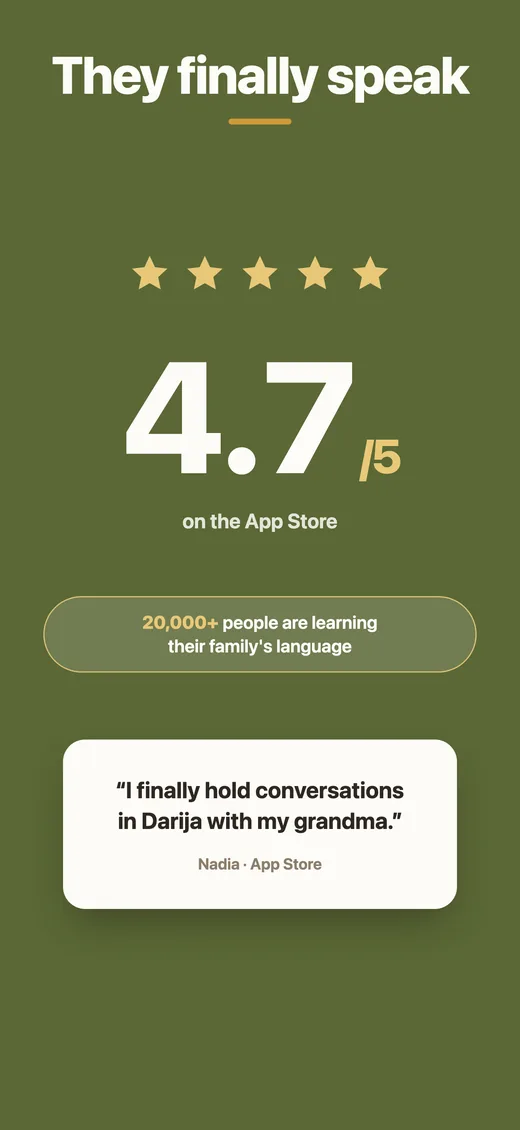
5 minutes a day · Free to start · 4.7/5 on the App Store
On a computer? Try the web app →