Best app to learn Moroccan Darija in 2026
You're looking for an app to learn Moroccan Darija — the Arabic spoken in Morocco — and you quickly discover the problem: the major platforms like Duolingo or Babbel don't offer it. Duolingo teaches only Modern Standard Arabic, a language nobody speaks spontaneously in Casablanca, Fez or Agadir, and Babbel has no Arabic course at all. This guide takes an honest tour of what really exists, and helps you choose based on your profile.
Which app should you use to learn Moroccan Darija? Quick answer (November 2026): Duolingo's Arabic course teaches Modern Standard Arabic, not Darija, and Babbel has no Arabic at all. The other options are specialized Darija apps, AI conversation apps and online tutors. For the Darija spoken at home, a specialized app like Dialect offers the everyday words and phrases, recorded by a native Moroccan speaker, in the Latin letters people use in texts, with spaced repetition and five-minute sessions on iPhone, Android and the web, free to start. It's made for the Moroccan diaspora, partners and travelers — details below.
This guide compares the options. For the app itself, with its words, phrases and audio, see our Moroccan Arabic app page.
Is Darija on Duolingo?
No. Duolingo does not teach Moroccan Darija; its only Arabic course is Modern Standard Arabic (course list checked on November 18, 2026). Standard Arabic is the language of school and the news in Morocco, not the one spoken at home, so finishing that course will not let you follow a conversation in Casablanca or Marrakech. Babbel has no Arabic course at all.
The other options are specialized Darija apps, AI conversation apps and online tutors, compared below. Dialect teaches the Darija spoken at home, recorded by a native Moroccan speaker, in the Latin letters people use in texts: learn Moroccan Darija with Dialect. Algerian Darija isn't on Duolingo either: see our Algerian Darija app comparison.
Why Moroccan Darija needs a dedicated app
Darija is not Standard Arabic
Modern Standard Arabic (fusḥa) is the language of school, TV news and official documents. Darija is the language of life: simplified grammar, its own vocabulary, different sounds. "How are you?" is kayfa ḥāluka? in Standard Arabic… and labas ʿlik? or ki dayr? in Darija. Learning the first will not help you understand the second: that is the classic letdown of learners who start with a generalist "Arabic" course.
A language shaped by several cultures
Moroccan Darija has absorbed centuries of influences: an Arabic core, an ever-present Amazigh (Berber) substrate, loanwords from French (tomobil, the car) and from Spanish (simana, the week, in the north). That blend is what gives it its flavor — and what makes it impossible to derive from Standard Arabic, or from neighboring Algerian Darija, despite the resemblance.
Pronunciation can only be learned by ear
The sounds ḥ (as in ḥanout, the corner store), ʿayn, gh or q don't exist in English. No transcription renders them faithfully: you have to hear them pronounced by a native speaker, several times, in real words. It's the first criterion to check before choosing an app — many settle for a text-to-speech engine built for Standard Arabic, which "reads" Darija with an artificial accent.
The 4 criteria of a good Darija app
- Audio recorded by native Moroccan speakers — not a synthetic voice. Your ear calibrates on what it hears: make sure it hears the real thing.
- Everyday vocabulary first — greetings, family, food, the market. Not "the airport" and "hotel reservations" in lesson 2: you're learning Darija to talk to people, not for a business trip.
- A real memorization system — spaced repetition brings each word back at the optimal moment, just before you forget it. Without it, much of what you study is quickly forgotten.
- Short sessions and visible progress — 5 minutes a day kept up for 3 months beats an hour every Sunday abandoned in January. The app should make consistency easy (streaks, milestones, reminders).
Dialect in practice, with screenshots
Dialect was built precisely for this use case: diaspora members and partners who want to speak (or speak again) the family's language. Moroccan Darija is treated as a language in its own right — not as a spin-off of Standard Arabic.
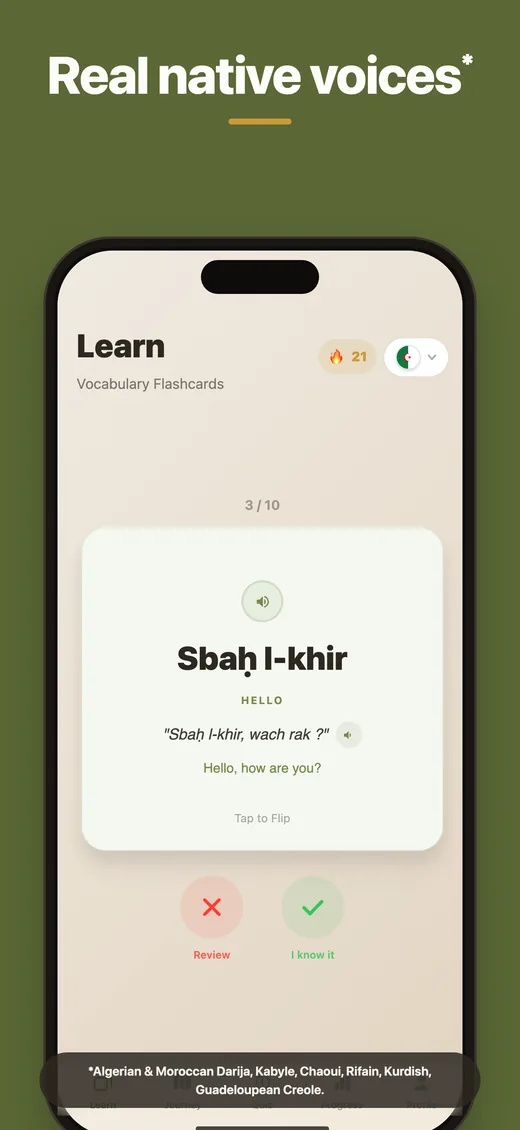
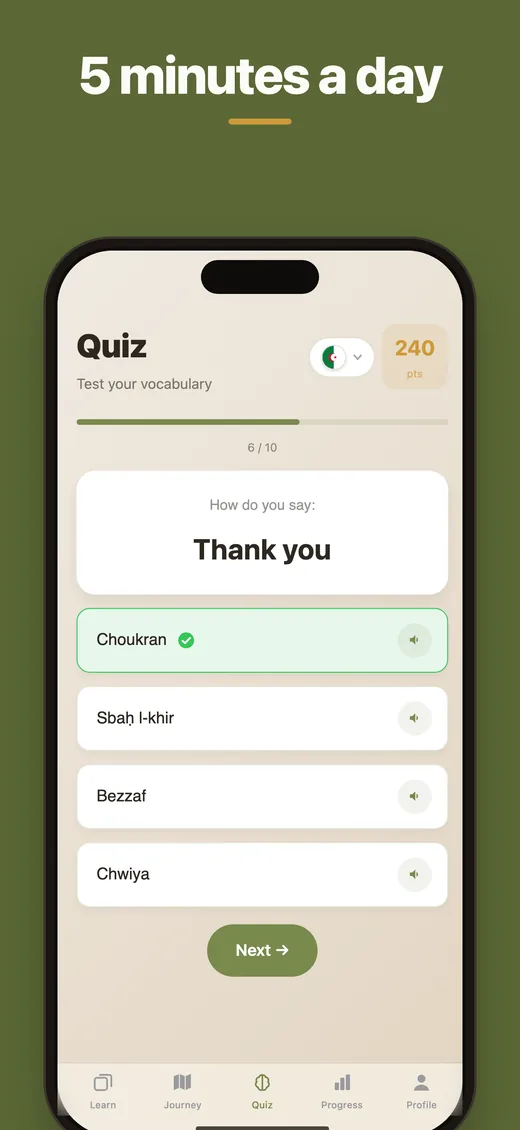
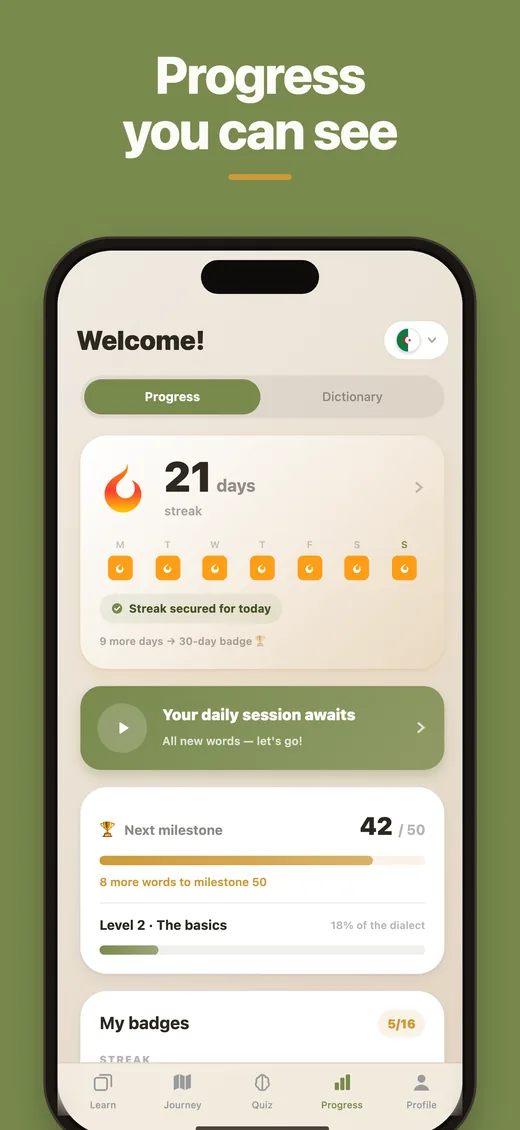
In concrete terms:
- 100% native audio for Moroccan: words and example sentences are recorded by a Moroccan speaker. You hear the real ḥ of ḥanout, not a text-to-speech approximation.
- The familiar Latin script: sbaḥ l-khir, choukran, bzzaf — the one the diaspora already reads in family texts. No need to master the Arabic alphabet before you start speaking.
- Flashcards, quizzes and level-based tracks with spaced repetition: easy words space out, hard ones come back.
- 5-minute sessions, daily streaks, milestones (50, 100, 200 words…): built to fit a busy life.
- Free to start, on iPhone, Android and the web.
An honest comparison of the alternatives
No app is perfect for everyone. Here is the real landscape in 2026:
The table is sorted by type of solution (major platforms, dedicated apps, courses, free resources), then alphabetically. Dialect, which publishes this guide, sits in its place like the others.
| Solution | Strengths | Limits for Moroccan Darija |
|---|---|---|
| Duolingo / Babbel / Rosetta Stone | Proven methods, huge catalogs | Do not offer Darija. Duolingo and Rosetta Stone teach only Modern Standard Arabic, and Babbel has no Arabic — you won't understand a Moroccan conversation |
| AI conversation apps | Spoken conversation with an AI voice, instant translation | The voice and the answers are generated by an AI, not recorded by speakers: generative AI can blend the dialects or suggest a phrasing nobody uses. Useful to dare to speak, best paired with listening to real voices (see Darija and AI) |
| Dialect | Native Moroccan audio (words + sentences), the everyday Latin script, spaced repetition, 5-min sessions, designed for the diaspora, on iPhone, Android and web | No formal grammar course |
| Memrise, user-made word lists (back in the app in 2026) | Flexible flashcards | Darija lists made by other users, not by Memrise: uneven coverage, audio rarely systematic |
| Specialized Darija apps | Morocco-centered, themed vocabulary lists | Content and memorization tracking vary from app to app; check that reviews are scheduled over time |
| YouTube / podcasts | Free, real immersion, excellent Moroccan creators | No structure and no review system: perfect as a complement, insufficient on its own for durable memorization |
Offerings checked in November 2026.
Which solution for your profile?
- You're from the diaspora and want to talk with family: Dialect, starting with greetings and family vocabulary. Add calls to your family — the best practice lab there is.
- You're moving to Morocco to live or work: Dialect for the daily spoken foundation, plus a structured course (online or in person) for grammar and writing.
- You also want Literary Arabic (reading, writing, following the media): start with Standard Arabic on a major platform, and add Darija alongside it for speaking — the two are not mutually exclusive.
- You just want a few phrases before a trip: our free guides (the differences between the Darijas, in French, and how to say hello) plus a week of Dialect cover the polite basics.
The method that works, whatever the app
An app is not everything: method is what makes you progress. Here is the one we recommend — and that Dialect orchestrates automatically:
- 5 to 10 minutes a day, every day. Consistency beats intensity, with no known exception in the research.
- Audio from day one. Listen to each word several times, repeat out loud — even alone in your kitchen.
- Trust the reviews. When a word comes back just as you thought you knew it, that is exactly when your memory needed it.
- Speak before you feel ready. From 50 words on, drop sbaḥ l-khir and choukran bzzaf into a family call. The smiles you'll get are worth all the badges.
Frequently asked questions
What is the best app to learn Moroccan Darija?
Check four things: words recorded by native Moroccan speakers, real Darija rather than Modern Standard Arabic, spaced repetition, and Darija in Latin letters so you can read it from day one. As of November 2026, Duolingo's Arabic is Standard Arabic and Babbel has none; specialized Darija apps, AI conversation apps and tutors are the other options. Dialect teaches everyday Darija with a native Moroccan voice, in five-minute sessions, free to start.
Is Moroccan Darija written in Arabic or Latin letters?
Both exist, but in everyday life (texts, social media), Moroccans mostly write Darija in Latin letters, sometimes with numbers standing in for sounds English doesn't have (7 for ḥ, 3 for ʿayn). Dialect uses this familiar Latin script, so you don't have to learn the Arabic alphabet before you can speak.
How long does it take to hold a simple conversation in Darija?
With regular practice of 5 to 10 minutes a day, most learners can handle simple exchanges (greetings, family, errands) within 2 to 3 months. Consistency matters more than session length: that is the principle of spaced repetition.
Is Dialect's Moroccan Darija audio really native?
Yes. Moroccan Darija words and example sentences in Dialect are recorded by a native Moroccan speaker, not by a text-to-speech engine. That is essential for acquiring the real pronunciation of sounds like ḥ, ʿayn or gh — and it's the #1 criterion we advise you to check everywhere else.
Moroccan or Algerian Darija: are they the same thing?
No, they are two close but distinct varieties (different vocabulary, accent and loanwords). Dialect treats them as two separate languages. Our guide to Algerian, Moroccan and Tunisian Darija (in French) details the differences.
5 minutes a day · 100% native Moroccan audio · 4.7/5 on the App Store
On a computer? Try the web app →
Further reading
- Learn Moroccan Darija: vocabulary and audio
- Algerian, Moroccan or Tunisian Darija: the differences (in French)
- Spaced repetition: the science behind the method
- Learning your heritage language as an adult
- Best app to learn Algerian Darija in 2026
- Best app to learn Tunisian in 2026
- Best app to learn Rifain in 2026
- Ce guide en français