Best app to learn Creole in 2026
You're looking for an app to learn Creole — the Creole of your Guadeloupean or Martinican parents or grandparents, the one you hear at family meals without daring to speak it — and you run into a first trap: most of the "Creole" resources that search engines and app stores return are for Haitian Creole, a related but distinct language. Duolingo, for instance, does offer a Creole course… Haitian Creole, taught from English only. For Guadeloupean Creole (and its Martinican cousin), the options are rarer — but they exist. This guide takes an honest tour of what's really out there in 2026, and helps you choose based on your profile.
Which app should you use to learn Creole? Quick answer (November 2026): If your family's Creole is Haitian, the one most Americans mean, Duolingo teaches it from English; in Dialect, Haitian Creole is text only, with no audio. For Guadeloupean or Martinican Creole, no major platform has a course: the options are small Creole mini-lesson and game apps, online courses and YouTube. For everyday Guadeloupean Creole, a specialized app like Dialect offers the essential words and phrases, recorded by a native speaker, with spaced repetition and five-minute sessions on iPhone, Android and the web, free to start; Martinican Creole is also available, partly recorded. It's made for Antillean families and their partners — details below.
This page compares the tools that exist for Creole. If you have already made up your mind, go straight to learn Creole with the Dialect app: Guadeloupean Creole, recorded by a native speaker.
Is Creole on Duolingo?
Only Haitian Creole. Duolingo teaches Haitian Creole, from English only, and has no course in Guadeloupean, Martinican or any other French Caribbean Creole (course list checked on November 18, 2026). Babbel and Rosetta Stone don't offer the Antillean Creoles either.
If your family's Creole is Haitian, Duolingo's course is a natural place to start; in Dialect, Haitian Creole is text only, with no audio. If it is Guadeloupean or Martinican, Dialect teaches everyday Guadeloupean Creole recorded by native speakers, and Martinican Creole, partly recorded: learn Creole with Dialect.
Why Creole needs a dedicated app
Creole is not "broken French"
This is the misconception to dismantle first, because it long served to devalue the language — including among those who spoke it. Guadeloupean Creole is a language in its own right, born in the 17th century from the encounter between French and the African languages of deported populations. Much of its vocabulary comes from French, but its grammar is its own: verbs are not conjugated — markers placed before the verb carry tense. An ka manjé: I eat (the marker ka expresses ongoing or habitual action). An ké manjé: I will eat (ké marks the future). No rule of French lets you deduce any of this. Speaking Creole isn't "mangling" French: it's speaking another language, with its own logic — and that is exactly why it has to be learned.
Guadeloupean, Martinican, Haitian: don't pick the wrong Creole
Each Caribbean Creole is a language in itself. Guadeloupean and Martinican are very close — people understand each other from one island to the other — with differences in vocabulary, accent and writing habits. Haitian Creole is noticeably more distant: "I love you" is an enmé-w in Guadeloupe and mwen renmen ou in Haiti. Yet the vast majority of apps, dictionaries and videos labeled "Creole" teach Haitian, carried by a much larger English-speaking diaspora. If your family comes from Pointe-à-Pitre, Basse-Terre or Marie-Galante, a Haitian Creole course will give you the basics… of another language. Always check which Creole a resource actually teaches.
A language passed down less and less — and relearned
In many Antillean families in mainland France, Creole skipped a generation. Parents or grandparents who arrived in the 1960s and 70s often set it aside, at a time when they were told Creole would "hold the children back" at school. The result: a whole generation understands Creole without speaking it — they follow the conversations, catch the little phrases tossed across the table, but can't find the words to answer. The good news: that passive foundation is an enormous accelerator. All it takes is a method that moves words from "I understand" to "I say" — native audio, scheduled reviews, and consistency.
The 4 criteria of a good Creole app
- Audio recorded by real speakers — not a synthetic voice. Creole is an oral language above all: its rhythm, its intonation, the music of ka ou fè? don't come through a machine trained on French. Your ear calibrates on what it hears; make sure it hears the real thing.
- The right Creole, clearly identified — Guadeloupean or Martinican if that's your family's Creole, not Haitian by default, nor a generic "Creole" that mixes everything together.
- A real memorization system — spaced repetition brings each word back at the optimal moment, just before you forget it. Without it, you retain a fraction of what you study; with it, the passive vocabulary of your childhood rises back to the surface.
- Short sessions and visible progress — 5 minutes a day kept up for 3 months beats an hour every Sunday abandoned in January. The app should make consistency easy (streaks, milestones, reminders).
Dialect in practice, with screenshots
Dialect was built precisely for this use case: diaspora members who want to speak their family's language again. Guadeloupean Creole is treated as a language in its own right, with its Creole spelling (bonjou, mèsi, ka ou fè?) — and Martinican Creole is offered separately, out of respect for the differences between the two islands.
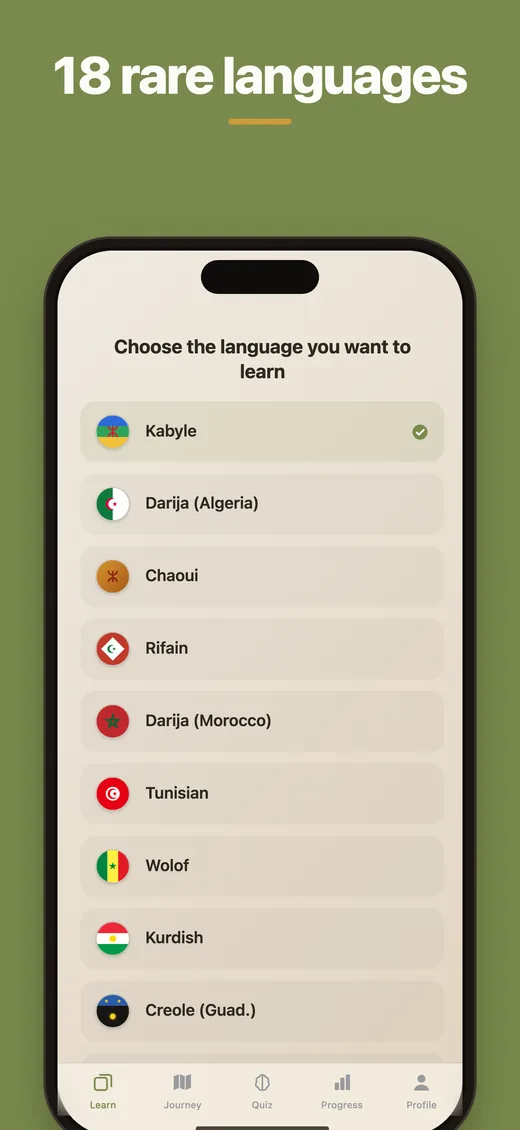
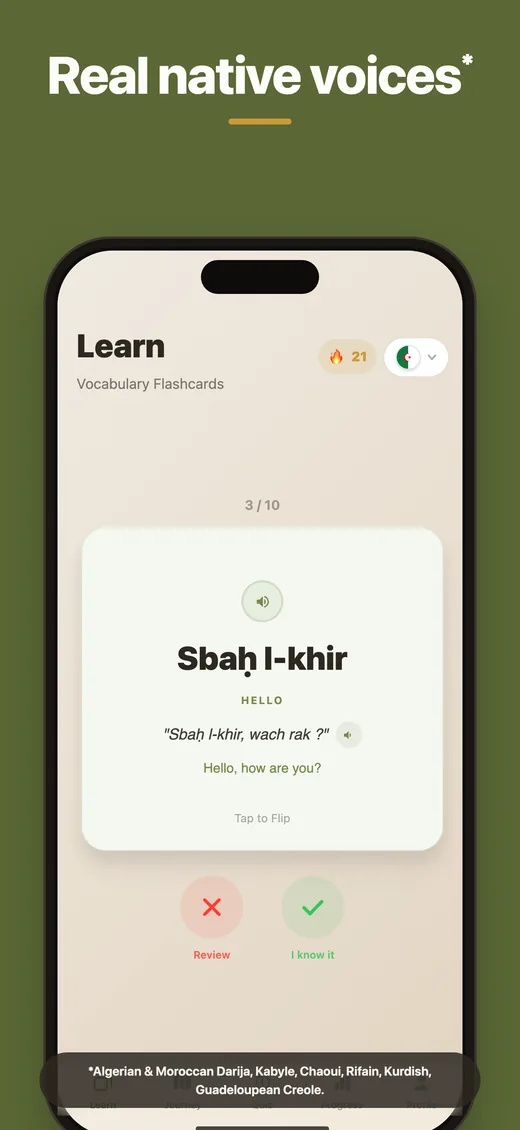
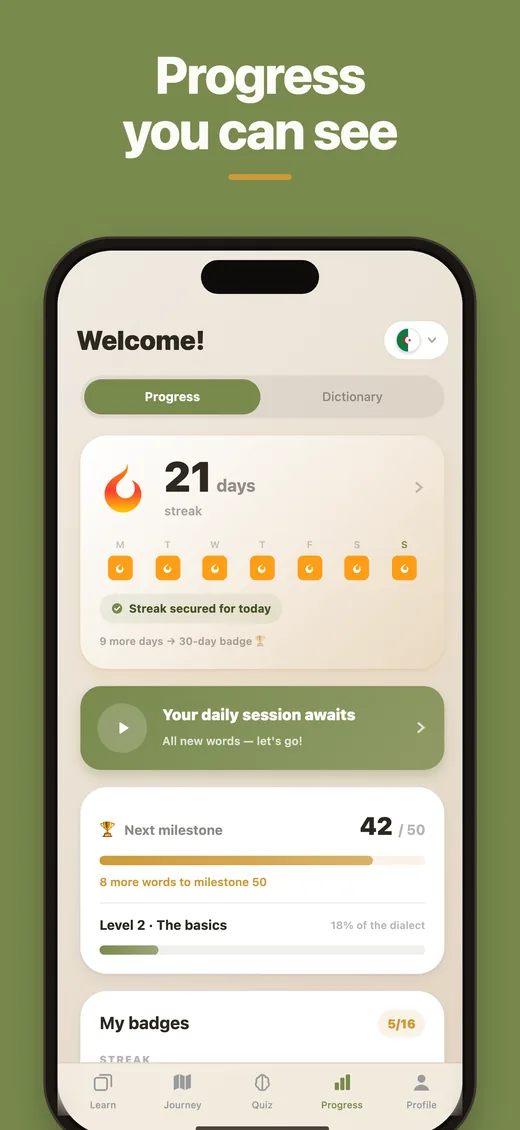
In concrete terms:
- 100% native audio for Guadeloupean Creole: words and example sentences are recorded by real speakers, never by text-to-speech. You hear the real ka ou fè?, with the intonation that goes with it.
- Everyday vocabulary first: bonjou (hello), bonswa (good evening), mèsi (thank you), ka ou fè? (how are you?), sa ka maché (I'm fine) — the vocabulary of family calls, not of a travel phrasebook.
- Flashcards, quizzes and level-based tracks with spaced repetition: easy words space out, hard ones come back.
- 5-minute sessions, daily streaks, milestones (50, 100, 200 words…): built to fit a busy life.
- Free to start, on iPhone, Android and the web.
An honest comparison of the alternatives
The options for French Caribbean Creole are limited but real, and several initiatives — often driven by Antilleans themselves — deserve to be known. Here is the landscape in 2026:
The table is sorted by type of solution (major platforms, dedicated apps, courses, free resources), then alphabetically. Dialect, which publishes this guide, sits in its place like the others.
| Solution | Strengths | Limits for Guadeloupean Creole |
|---|---|---|
| Duolingo / Babbel / Rosetta Stone | Proven methods, huge catalogs | Do not offer French Caribbean Creole. Duolingo teaches Haitian Creole, from English only — a neighboring but different language |
| Dialect | 100% native Guadeloupean audio (words + sentences), Martinican also available (partly recorded), spaced repetition, 5-min sessions, designed for the diaspora, on iPhone, Android and web | No formal grammar course |
| Creole game and discovery apps | Several Creoles side by side, proverbs, fun family-friendly formats | Geared toward games and discovery rather than structured progress with spaced reviews |
| Creole mini-lesson apps | Short structured lessons, grammar, quizzes and challenges | Centered on lessons rather than scheduled vocabulary memorization; each teaches one variety (Martinican, Guadeloupean…), so check that it is yours |
| Online Creole courses and programs | Full courses (in French), detailed grammar explanations, guidance | Long-course format, less suited to a daily 5-minute practice; no automatic review system |
| YouTube / TikTok / podcasts | Free, real immersion, passionate Antillean creators | No structure and no reviews, and much "Creole" content is actually Haitian: perfect as a complement, insufficient on its own |
Offerings checked in November 2026.
Which solution for your profile?
- You're from the Antillean diaspora and want to talk with family: Dialect, starting with greetings and family vocabulary. Add calls back home and family meals — the best practice lab there is.
- You understand Creole but don't speak it: that's the profile that progresses fastest. Spaced repetition reactivates your passive vocabulary; within a few weeks, the answers come on their own.
- You also want grammar in depth (writing Creole, understanding its structure): Dialect for the daily oral foundation, plus a structured online course for grammar and writing — the two complement each other.
- Your family is Martinican: choose Martinican Creole in Dialect rather than Guadeloupean — the two languages are close, but your family will hear the difference.
- You just want a few phrases before a trip to Guadeloupe: our free guides (how to say hello in 15 languages) and a week of Dialect are enough for the basics of politeness — bonjou, mèsi, pa ni pwoblèm.
The method that works, whatever the app
An app is not everything: method is what makes you progress. Here is the one we recommend — and that Dialect orchestrates automatically:
- 5 to 10 minutes a day, every day. Consistency beats intensity, with no known exception in the research.
- Audio from day one. Listen to each word several times, repeat out loud — Creole lives out loud, even alone in your kitchen.
- Trust the reviews. When a word comes back just as you thought you knew it, that is exactly when your memory needed it.
- Speak before you feel ready. From 50 words on, drop bonjou and ka ou fè? into a family call. The pride you'll read on your elders' faces is worth all the badges.
Frequently asked questions
What is the best app to learn Creole?
First, be sure which Creole you need: Haitian, Guadeloupean and Martinican are related but different. Then check for native recordings, spaced repetition and a consistent Latin spelling. As of November 2026, Duolingo teaches Haitian Creole from English; for the Antillean Creoles, small Creole apps, online courses and YouTube are the options. Dialect teaches Guadeloupean Creole recorded by a native speaker, and Martinican Creole, partly recorded, in five-minute sessions, free to start. Dialect's Haitian Creole is text only, with no audio.
Guadeloupean, Martinican, Haitian Creole: what are the differences?
Guadeloupean and Martinican belong to the Creole of the Lesser Antilles: they are very close and largely mutually intelligible, with differences in vocabulary, accent and spelling. Haitian Creole is more distant: "I love you" is an enmé-w in Guadeloupe and mwen renmen ou in Haiti. Speakers partly understand each other, but learning one is not the same as speaking the other. Dialect treats Guadeloupean and Martinican as two separate languages.
Is Creole a real language or just broken French?
It is a real language, with a grammar of its own. Much of the vocabulary comes from French, but the structure is different: verbs are not conjugated — markers placed before the verb express tense (ka for ongoing or habitual action, ké for the future). An ka manjé means "I eat", an ké manjé "I will eat". A Creole sentence cannot be derived from French: it has to be learned.
How long until you can hold a simple conversation in Creole?
With regular practice of 5 to 10 minutes a day, most learners hold simple exchanges (greetings, family, daily life) within 2 to 3 months. It's even faster if you already understand Creole without speaking it: spaced repetition reactivates vocabulary you already possess passively.
Is Dialect's Guadeloupean Creole audio really native?
Yes. Guadeloupean Creole words and example sentences in Dialect are recorded by real native speakers, not by a text-to-speech engine. That is essential for acquiring the music of the language: Creole intonation and rhythm can only be learned by ear.
5 minutes a day · Native Guadeloupean audio · 4.7/5 on the App Store
On a computer? Try the web app →